


Most leaders assume teams get better at working together over time. Experience builds intuition. Repetition builds cohesion. Eventually you get something greater than the sum of individual parts.
Research from the Collective Intelligence Labs at the Stockholm School of Economics says that’s wrong. And the failure mode it creates is worse than most people realize.
Researchers Philip Runsten and Andreas Werr studied 50 knowledge-intensive teams across 22 organizations over two months. Half got a structured digital debrief designed to make their coordination visible. The other half just kept working as normal.
The control teams didn’t hold steady. They declined. Observer-rated performance dropped roughly 6.5%. Self-rated performance dropped 4.6%. No disruption, no crisis. Just the quiet erosion of coordination quality that nobody was watching.
The intervention teams improved by 15-21%.
The default trajectory for a team left to its own devices isn’t improvement through experience. It’s decay through inattention.
That’s already uncomfortable. But here’s the part that really got me.
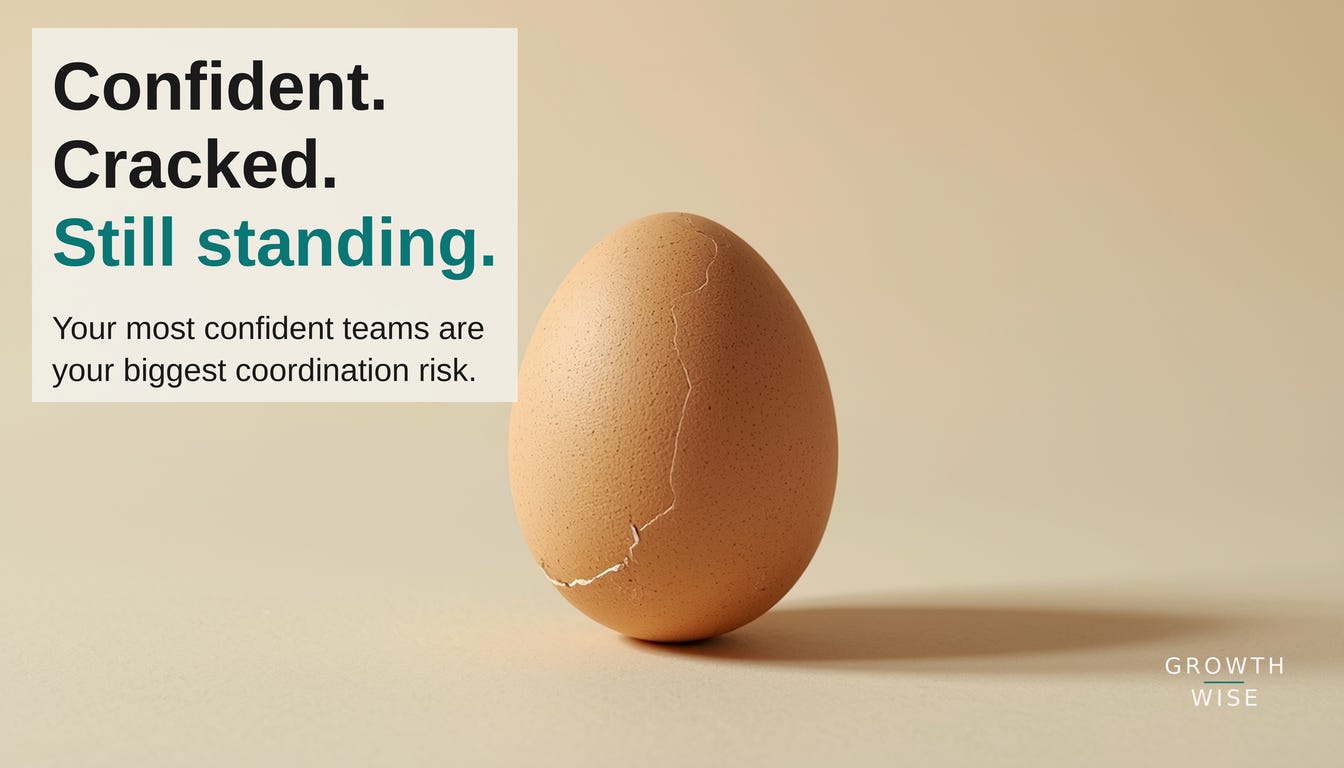
When the researchers segmented teams by performance, a specific cluster emerged: teams ranked just below the top. The “second best.” When the intervention came in and made their coordination visible, they didn’t improve. They got worse. And they resisted the whole process.
Their profile before the intervention told the story. Weaker task understanding than the top performers. Lower integration behaviors — less peer coaching, fewer real challenges to each other’s thinking. Lower psychological safety. And they consistently rated their own performance higher than outside observers did, by a margin that didn’t budge before or after the intervention.
One team member summarized it: “My strongest impression is that we as a team already are very good at many of the things this study wants to demonstrate, which is positive!”
Another said the intervention “created some discontent and irritation.”
The self-overrating gap — 0.36 units between self-assessment and observer rating — was exactly the same before and after. The feedback landed and changed nothing.
Compare that to the top-performing teams, who actually rated themselves lower than observers did. The best teams were humble about their coordination. The second-best teams were confident about theirs. The confidence was unfounded.
This is the catch-22. The teams most at risk are the ones least likely to seek help, least likely to accept feedback, and most likely to believe they don’t have a problem. They’re performing well enough that no one intervenes. They’re confident enough that they resist when someone does.
And they’re succeeding on familiar terrain. Output looks fine because the tasks are within range — routine enough that individual competence carries the performance, even as the actual quality of collaboration thins out underneath.
The moment the task becomes genuinely ambiguous — a novel strategic decision, a cross-functional tradeoff with no clear precedent, a situation where no single person holds enough context — those teams have nothing to fall back on. The integration behaviors were never practiced. The psychological safety to say “I don’t understand” or “I disagree” was never built.
They’ll walk into a high-stakes moment with the same confidence they’ve always had. And the coordination was never there.
This is how organizations produce decisions that, in retrospect, seem inexplicable. Not from obviously dysfunctional teams. From capable teams whose coordination was never made visible.
One more finding worth sitting with: the structured digital debrief achieved performance improvements comparable to facilitator-led interventions that typically show 20-25% gains.
You don’t need a consultant in the room. You need a reliable mechanism for making coordination visible to the team itself.
Reference
Runsten, P. and Werr, A. (2020). Knowledge Integration and Team Performance — The Effect of a Digitally Supported Team Debrief. Collective Intelligence Labs, Stockholm School of Economics.