


Every ops leader I’ve seen try to fix meetings follows the same path.
First they add transcription. Otter, Fireflies, Fathom, etc. Now there’s a record of what was said. The problem doesn’t go away.
So they add action tracking. Fellow, Grain, Tactiq. Now there are documented next steps. The problem still doesn’t go away.
Some go further and pull in calendar analytics. Viva Insights, Worklytics, Clockwise. Now they can see how overloaded people are. The problem still… you know where this is going.
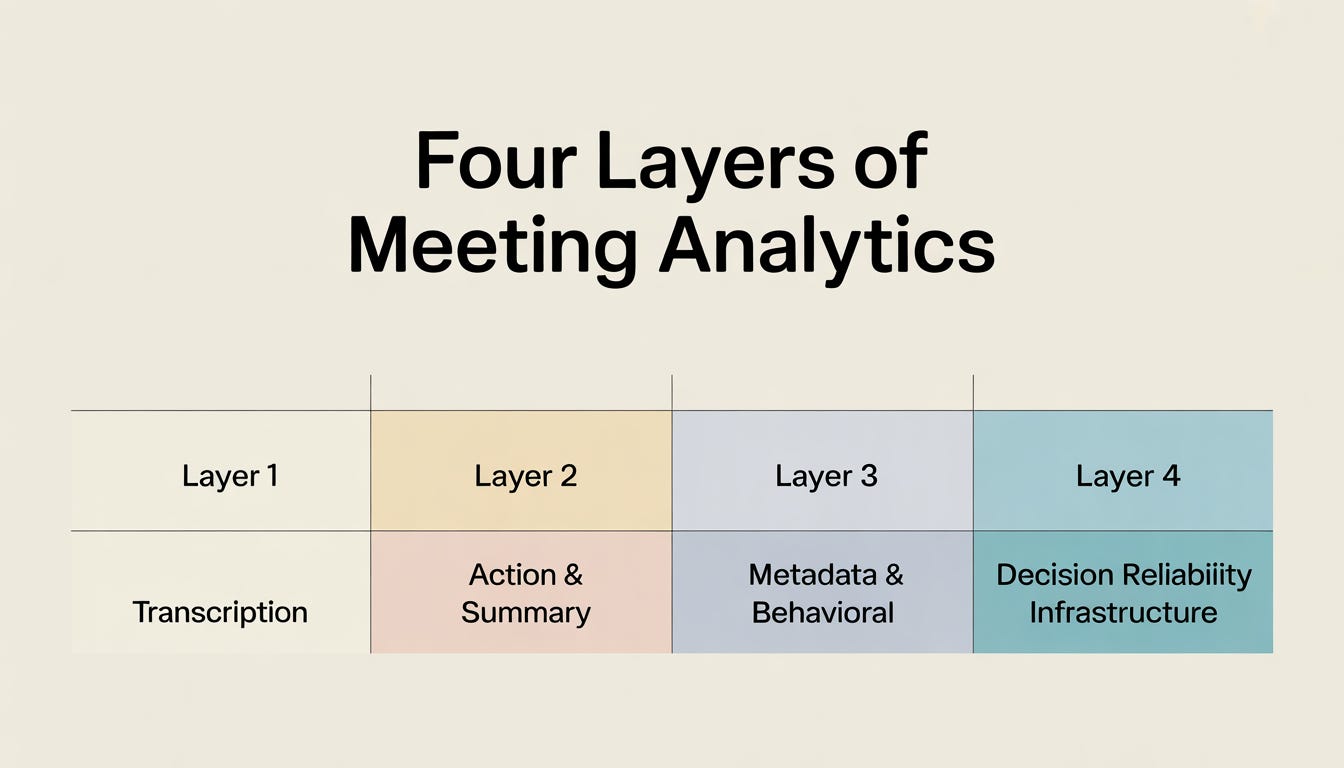
Here’s what’s actually happening. The meeting analytics market operates across four distinct layers, and most organizations stop at layers one or two. Not because the tools are bad. Because they’re solving the wrong problem.
Layer 1 answers: what was said.
Layer 2 answers: what should we do next.
Layer 3 answers: how much time are we spending.
Layer 4 answers: what’s structurally going wrong.
Almost every ops team I’ve watched is buying Layer 1 and 2 tools to solve a Layer 4 problem. That’s why nothing changes.
The structural problem — the one that actually explains why teams have the same conversation twice, why decisions collapse in execution, why alignment reached in a meeting dissolves by Thursday — isn’t captured in a transcript. It’s not in the action items and it’s not in the calendar data.
It’s in the coordination layer. Whether decisions actually closed. Whether the “agreement” in the room was genuine or just the least-confrontational path to ending the meeting. Whether the person who said “I’m aligned” had any intention of following through, or just didn’t want to relitigate.
A transcript cannot tell you that. A task tracker cannot tell you that. A calendar heatmap definitely cannot tell you that.
The gap isn’t tool failure. It’s architectural. The meeting problem isn’t that people forget what was discussed — that’s a Layer 1 problem, and it’s mostly solved. The meeting problem is that nothing gets decided. Or something gets “decided” but doesn’t hold. Or the same conflict surfaces three meetings later because no one actually resolved it the first time.
That’s a structural failure. It requires structural instrumentation.
Layer 4 doesn’t replace the other layers. Transcription is table stakes. Action tracking matters. Calendar analytics can tell you when a team is drowning. But none of them show you where the coordination broke down — which conversation never closed, which decision had no owner, which moment of false agreement set up three weeks of rework.
That’s the layer most organizations are missing. And it’s the one that explains why adding another tool hasn’t fixed anything.
I wrote a full breakdown comparing the tools across all four layers, which ones do what, where they fall short, and what to look for if you're actually trying to fix the coordination problem.