


Afoot, the AI platform I’ve been building for the last year, is operational infrastructure for high performing teams. It’s designed for organizations who want to break free of the mediocrity, who want to push for higher operating standards, who know they have what it takes to be exceptional at what they do.
It’s for this reason Afoot asks teams to do one thing in meetings: say what you decided, and who’s doing what. Out loud. Clearly. On the record.
This sounds so obvious it barely counts as advice. And yet, for many, it is like a request to get undressed. People go quiet. They begin to hedge and find reasons to “circle back” next week.
So I’ve been asking myself WHY
Why can’t we make decisions? Why aren’t we willing to clarify our commitments to one another face-to-face? Something that should feel intuitive and completely normal, feels foreign and uncomfortable instead. I don’t think it’s because people are lazy or scared.
I think something in the environment has changed.
A team is made by what they choose
Soren Kierkegaard, the Danish philosopher and one of the foundational thinkers of existentialism, was concerned with how a person actually lives, chooses, and becomes themselves. He described a way of living called the aesthetic life. The aesthete lives for what comes next. He chases novelty and endless possibilities. Every choice gets postponed because choosing would close a door, and the aesthete’s whole policy is to keep the doors open. It’s a philosophy many of us, myself included, lived by for most of our 20s. Kierkegaard’s point was that this person never really becomes anyone.
Because, according to him, a person is made by what they choose.
I’ve begun to wonder whether a lot of us, well past our 20s, are stuck in some version of this now. Abundance and optionality is the code we live by. Portfolio careers and superficial relationships held until something better comes along. Every decision reversible and every commitment provisional. Everything a tentative “yes”.
And I think it’s spilled into our professional lives too.
Sit quietly in your next meeting and watch the room avoid a decision. What you’ll see is the aesthete. The nods that mean nothing. The same topic that comes back week after week as if it’s never been discussed before. There is no disagreement because actual disagreement would be a choice. What you will witness is optionality preserved.
Fake agreement IS optionality preserved.
A life of abundances doesn’t make us more decisive. It makes deciding feel unnecessary. Why pick a path when you can keep all of them?
The tech industry may be the worst offender of all
The aesthete philosophy seems to dominate the tech industry right now. We took Jeff Bezos’ “two-way door”and applied it to everything. If any decision can be undone next sprint, no actual decisions need to be made this sprint. Optionality has become our collective personality. The person who commits looks naive and close minded. The person who keeps the options open looks smart.
I’ve sat in enough tech leadership meetings to know what this mentality produces. It becomes product roadmaps nobody believes, priorities that get “revisited” quarterly, which actually means monthly, which really means whenever someone senior has a new idea or got inspired by the latest Lenny’s podcast. It’s ownership that is assumed instead of accepted.
And then, just when the capital markets were about to force us to converge, to take some modicum of accountability, we were given the most powerful option-generating machine ever built.
AI is terrible for a team that can’t make decisions.
With intelligence on tap, we now have three drafts where there used to be only one, five prototypes built while we sleep. A deck that explores every direction with an appendix for the best-medium-worst case scenario calculated to perfection. Every meeting now ends with more possibilities than it started with. Unfortunately, it also ends with the same amount of commitment as before, which is none.
We were already drowning in options, AI just turned on the tap.
Fake agreement is sensible math
Now, I want to be careful here. Because I’m not trying to turn this into a lecture about character. That is not it. This behaviour makes perfect sense.
As growth and marketing leader for startups, I’ve spent a great deal of time guiding teams through the “groan zone”. A term coined by the expert facilitator Sam Kaner. The “groan zone” is the uncomfortable stretch in any complex project where a group tries to move from ideas to decisions, cognitive overload kicks in, and leaders often skip the hard work of integration. The result is often watered-down compromise instead of real alignment.
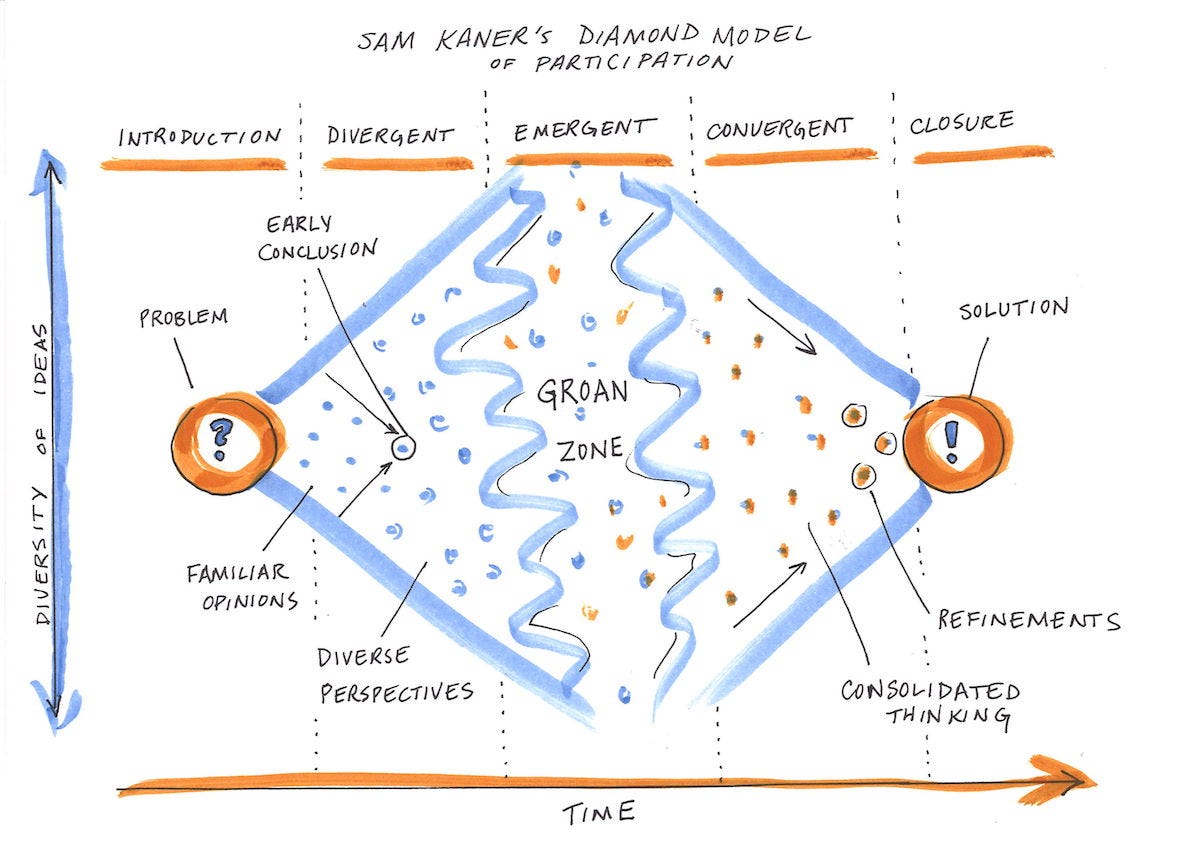
Gaining wisdom requires sitting in the “groan zone”. Innovation requires it too. But people will only sit in that discomfort when they are confident that what comes out of it will actually lead somewhere. Nobody volunteers for hard conversations whose outcome disappears when the meeting ends. When decisions don’t stick and accountability is vague, avoiding the friction isn’t a failure, it’s just sensible math.
So that’s the thing. We aren’t shallow people, we are acting quite rationally. We’ve done the math in this environment of abundance and concluded that committing costs more than it pays. So instead, we drift and call it flexibility.
A lack of psychological safety is a part of the problem, but for many capable teams this has much more to do with a lack of infrastructure and incentives than it does with fear of retribution.
Which means the fix isn’t a workshop on decisiveness. Leaders have to deliberately engineer dissent, and make sure it pays well to be decisive and make commitments.
You don’t fix a pricing problem with a pep talk. You change the price.
While AI is giving us endless options and our agents are collapsing the cost of production, the only thing left is the deciding. Which draft? Whose call? Who owns it? What are we actually committing to? Because there is more output to decide about and less time between rounds, the judgment and convergence part is now the expensive bottleneck.
To make matters worse, now we have agents in the room. Humans have the innate ability to sense when a decision didn’t really land, AI agents do not. They act on whatever was written down, confirmed or not. Until recently, the cost of fuzzy, ambiguous coordination was a bit of friction: a few repeat meetings or a slow handoff. Now, poor coordination multiplies fast and can come at an incredible cost. Not least of which is massive token burn.
The cost of doing is collapsing. The cost of deciding is just getting started.
Coordination AI
This is the problem my co-founder John Sjölander and I are building to address, and it needed a name. We call it "Coordination AI”. In plain terms: it’s AI whose job isn’t to make more, but to keep true what the humans decided.
Almost every AI product you use today is built to remove friction. Coordination AI does something rather odd by comparison. It puts one piece of friction back on purpose. The type of good friction added earlier in the process so everything downstream runs smoother and encounters less bad friction.
Confirmed human authority.
The good kind of friction
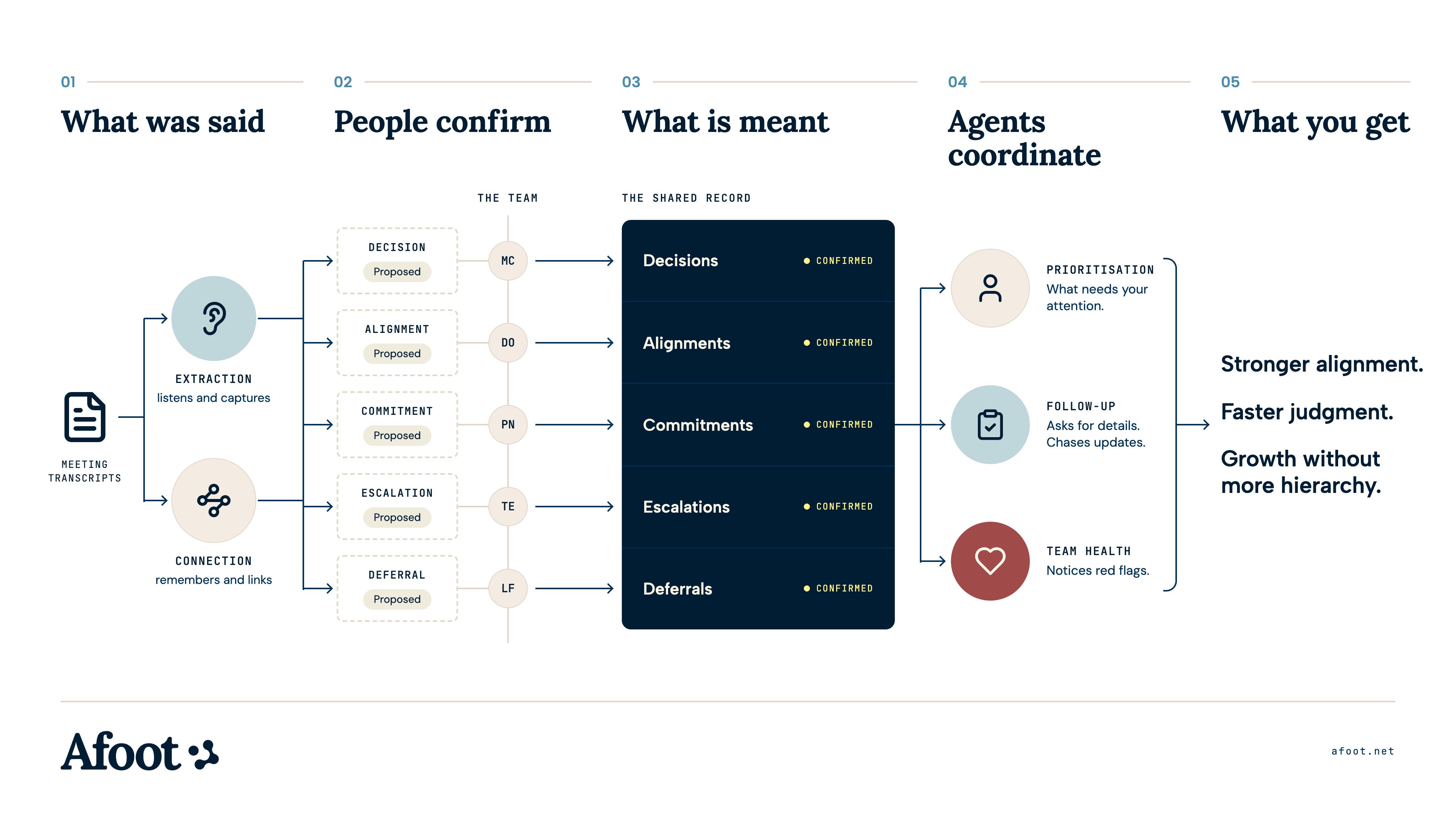
After a meeting (i.e. the highest fidelity coordination moment there is), Afoot proposes what it heard: this was decided, you committed to that but didn’t set a deadline, this got parked for later, this issue needs input from X. Then it asks the people in the room to say: “yes”, “no”, or “not quite, it was this”. Nothing enters the shared record without human judgment.
That pause is the whole product. You cannot have a real commitment without someone accepting it with intention. If you take away that pause what you end up with is a meeting summary. And as we all know, meeting notes are usually one person’s version of reality, or worse, just better-formatted ambiguity. If you keep the reflective pause, you finally change the price of commitment.
With Afoot, commitments are now owned, visible, and explicit. Decisions stay closed and flow to the relevant areas of the organisation immediately (thanks to a team of coordination agents working behind the scenes), instead of waiting on a middle manager to call another status update meeting.
Finally, the hard conversations lead somewhere, so people are willing to have them.
Becoming someone. Becoming a team.
Kierkegaard wasn’t describing a productivity problem. He was describing how a person becomes real. The aesthete stays in possibility forever and never turns into anyone.
Teams are the same. A team that never closes anything isn’t a team yet. It’s a group of people keeping their options open near each other. The moment the team decides, and means it, and can point to a record of that decision months later, it becomes something.
For Kierkegaard, choosing was how you become someone. I think it’s how a team becomes one too. Coordination AI, and Afoot specifically, is just the infrastructure that makes the choosing count.
Afoot will soon be live. Join the waitlist for early access.
"Fake agreement is optionality preserved" is the line I'll keep. The nods that mean nothing and the topic that comes back every week as if it were new are easy to recognize. Changing the price of deciding is the fix I'd act on: if a decision has no owner and nobody checks it the following week, avoiding the friction is the sensible move.