


You’ve been in that meeting. The one where something actually happened. Nobody was performing. Nobody was waiting for their turn to talk. Ideas were building on each other in real time.
What group flow actually is
Researchers define it as an emergent property of a social system, when members are so in sync that the group operates as a single unit and produces outcomes that exceed what any individual could have reached alone. Mihaly Csikszentmihalyi first mapped the individual version: total absorption, loss of self-consciousness, time distortion, intrinsic reward. Keith Sawyer extended it to groups, studying jazz ensembles, improv theater, and business teams to identify exactly what makes the collective state possible.
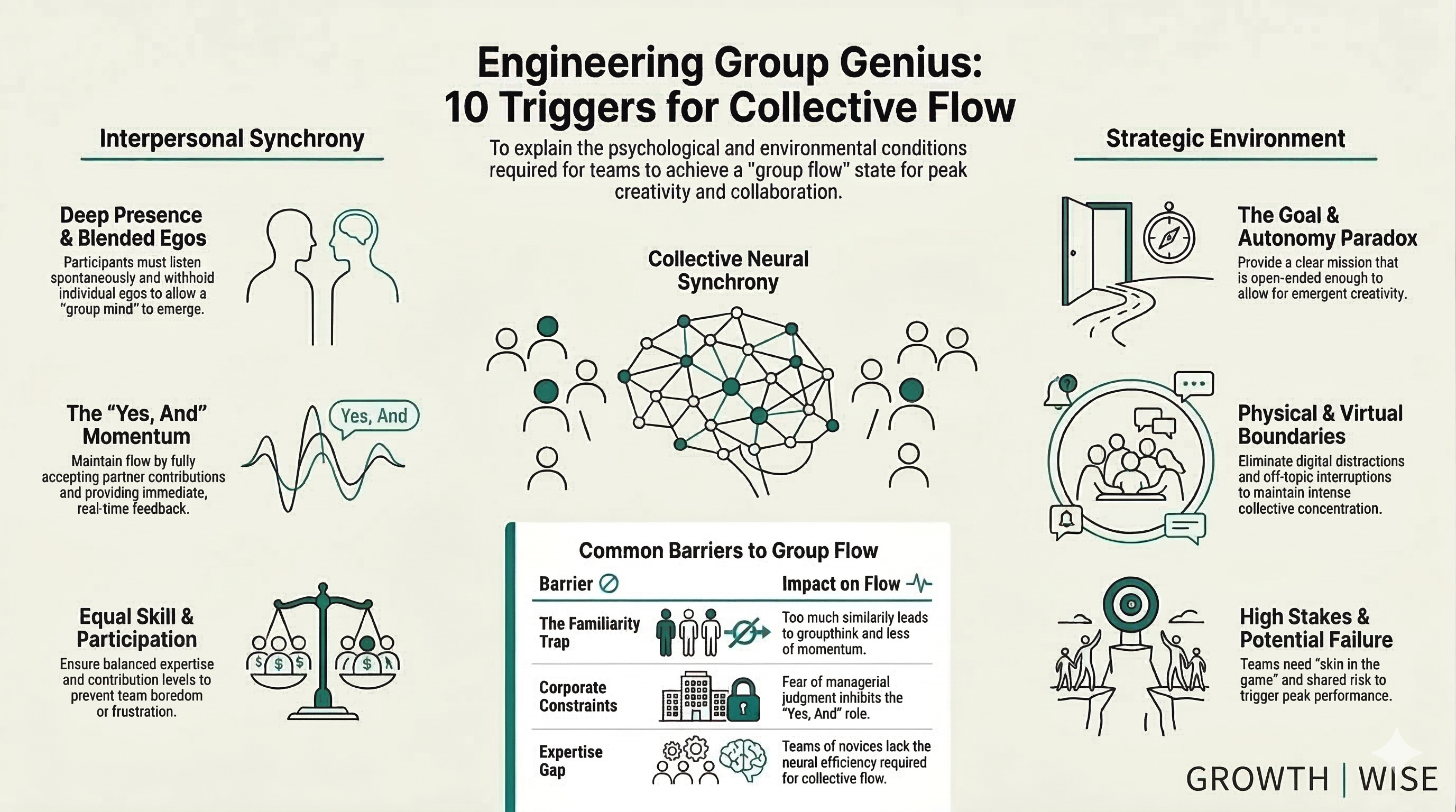
Sawyer identified ten specific conditions that have to be present for a group to enter that state:
The Paradox of the Group Goal: A compelling shared mission, open-ended enough for emergent creativity to surface
Deep Listening and Presence: Responding spontaneously to what’s actually being said, not rehearsing your next point while others speak
Complete Concentration and Environmental Boundaries: A clear boundary, physical or virtual, that eliminates distraction and shifts the group into a performance state
The Autonomy and Control Paradox: Each member feels individual agency while remaining willing to surrender to the collective direction
Blending Egos into a Group Mind: No one needs to be the center of attention; ideas build as if the group is a single unit
Equilibrium of Skills and Equal Participation: Everyone contributes their expertise at the moment it’s most relevant; no one is spectating
Familiarity and the Common Language: A shared knowledge base and unspoken communication style that reduce friction and speed up decision-making
Constant Communication and Immediate Feedback: Synchronous, spontaneous, real-time exchange that lets the group course-correct without breaking momentum
Momentum through the “Yes, And” Principle: Every contribution gets accepted and built on; negating ideas kills collective momentum
The Necessity of Potential Failure: Shared skin in the game — mental, social, or physical risk — creates the high-stakes environment that triggers intense focus
The neuroscience backs it up. When groups achieve genuine flow, their brains literally synchronize, with measurable alignment in neural oscillations, particularly in the beta and gamma frequency bands. Inter-brain synchrony peaks during collaboration and drops during conflict or stress. When jazz musicians improvise together, synchronization across temporal, parietal, and occipital regions increases significantly. The group is not a metaphor. It’s a measurable biological state.
How meetings kill every condition that makes it possible
Every single condition required for group flow is systematically dismantled by the way most organizations run meetings.
Sawyer’s triggers require deep presence: nobody writing their next point while someone else is still talking. Status meetings reward prepared remarks, polished updates, the performance of having things under control. Group flow requires ego dissolution, the willingness to let the group’s direction supersede your individual agenda. Most meetings are structured around individual agendas. Group flow requires equal participation and shared risk. Most meetings concentrate both speaking and accountability at the top of the hierarchy.
Why the system stays broken
The research on why this happens is not flattering. Deci and Ryan’s Self-Determination Theory identifies three non-negotiable human needs: competence, autonomy, and relatedness.
When deep work is impossible because the day is fragmented, people can’t demonstrate competence through output, so they perform it in meetings instead.
When calendars are controlled by other people’s invitations, calling a meeting becomes one of the few available acts of autonomy.
When teams are too large for genuine collaboration, being in the room becomes a proxy for belonging, and being excluded triggers the same threat response as social exclusion.
A McKinsey survey of 1,200 executives found that fewer than half report their decisions are timely, and 61% say at least half the time they spend making decisions is ineffective. Most organizations never fix this because the people with the authority to change the system are the same people whose needs it serves.
Atlassian surveyed 5000 knowledge workers and found even more compelling evidence of the complex:
Meetings are ineffective 72% of the time
78% of people we surveyed say they’re expected to attend so many meetings, it’s hard to get their work done.
77% of meetings end with a decision to schedule another meeting
54% of workers leave meetings without knowing what to do next or who owns the tasks
75% find meetings ineffective for making collaborative decisions
72% find meetings ineffective for creating goal clarity
Ryan Moser wrote a great piece on this recently.

The direct conflict
Group flow requires the psychological safety to say “I don’t know,” to build on someone else’s idea rather than compete with it, to fail in front of the group without career consequence. The meetings industrial complex makes those things feel dangerous. You don’t lose self-consciousness in a room where your competence is under constant evaluation. You don’t listen deeply when you’re calculating whether speaking up will help or hurt you.
We’ve known for decades what genuine collective thinking requires. We’ve built organizational systems almost perfectly calibrated to prevent it.
Meetings stay broken because the people who could fix them don’t experience them as broken. And group flow stays rare because we keep trying to get it from a room designed for something else entirely.
Sources: Csikszentmihalyi, Flow; Sawyer, Group Genius; Deci & Ryan, Self-Determination Theory; McKinsey time management research