
A month ago, Jack Dorsey and Sequoia published a provocation: what if AI could replace middle management entirely?
The idea centres on what they call a "World Model." A centralised system that ingests every Slack message, document, meeting transcript, and KPI to create a continuously updated digital twin of the organisation. AI uses that picture to infer priorities, surface insights, and guide action. With comprehensive, real-time context available to everyone, the information asymmetry that managers exist to solve would disappear. People closest to the work would know what is happening and what should happen next, without waiting for direction to travel down a chain of command.
The argument contains a real insight. Middle management, as most organisations practice it, is an expensive patch for a bandwidth problem.
“There is no need for a permanent middle management layer. Everything else the old hierarchy did, the system coordinates, and everyone is empowered, with a role that’s much closer to the work and the customer.”
—Jack Dorsey and Roelof Botha
But solving the information problem does not solve the coordination problem. Context without commitment is just a well-informed group of people drifting in different directions. The hardest coordination problems are commitment problems.
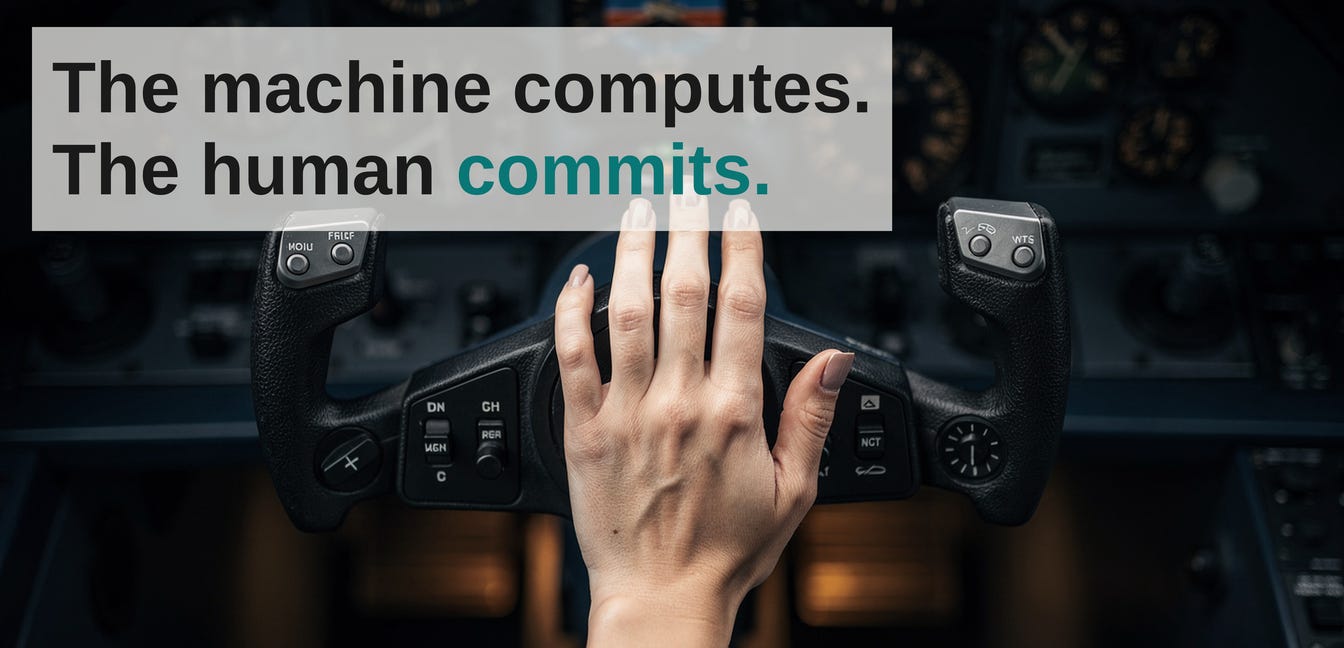
And commitment is a social act, not a computational one.
Context without commitment is noise
Organisations don’t fail because they don’t know what to do, they often fail because no one is clearly accountable for doing it.
You can give every person in the organisation the entire company’s data, strategy, and real-time signals. It doesn’t matter. Nothing becomes real until someone owns what happens next.
What people agreed to matters more than what the algorithm predicted.

We are pilots, not sensors
At enterprise scale, the World Model makes centralised sense-making the default. The system models the world; humans feed it data from the edges. The AI does the high-status work: sense-making, prioritisation, strategy. Humans execute and refine its outputs. The human gets to pick from a shortlist the machine already curated.
That is not leadership. That is editing.
We reject that inversion. The human is the sovereign pilot, the sovereign creator. By “sovereign,” we mean the one who holds judgment and is accountable for what happens next.
The AI does not route the human; the human uses the AI to structure their intent. AI can and should enhance local judgment, surface patterns humans miss, and accelerate the thinking that precedes every commitment. The question is who remains sovereign in the loop.
Where intelligence lives
The World Model centralises sense-making. One system ingests everything, computes priorities, and distributes direction to the edges. The people closest to the work receive guidance from a system that does not share the consequences of their decisions.
We believe judgment becomes meaningful where the work happens: in the negotiation between people at the point of contact. The system’s job is not to decide. It is to make what was decided visible, durable, and shared.
Complicated -vs- complex
The World Model is strongest on complicated work. It struggles where work becomes genuinely complex.
Complicated work has right answers. It can be decomposed, analysed, and optimised. Complex work has competing priorities, ambiguous signals, and tradeoffs that only make sense in hindsight.
You cannot optimise your way through complexity, you have to coordinate your way through it.
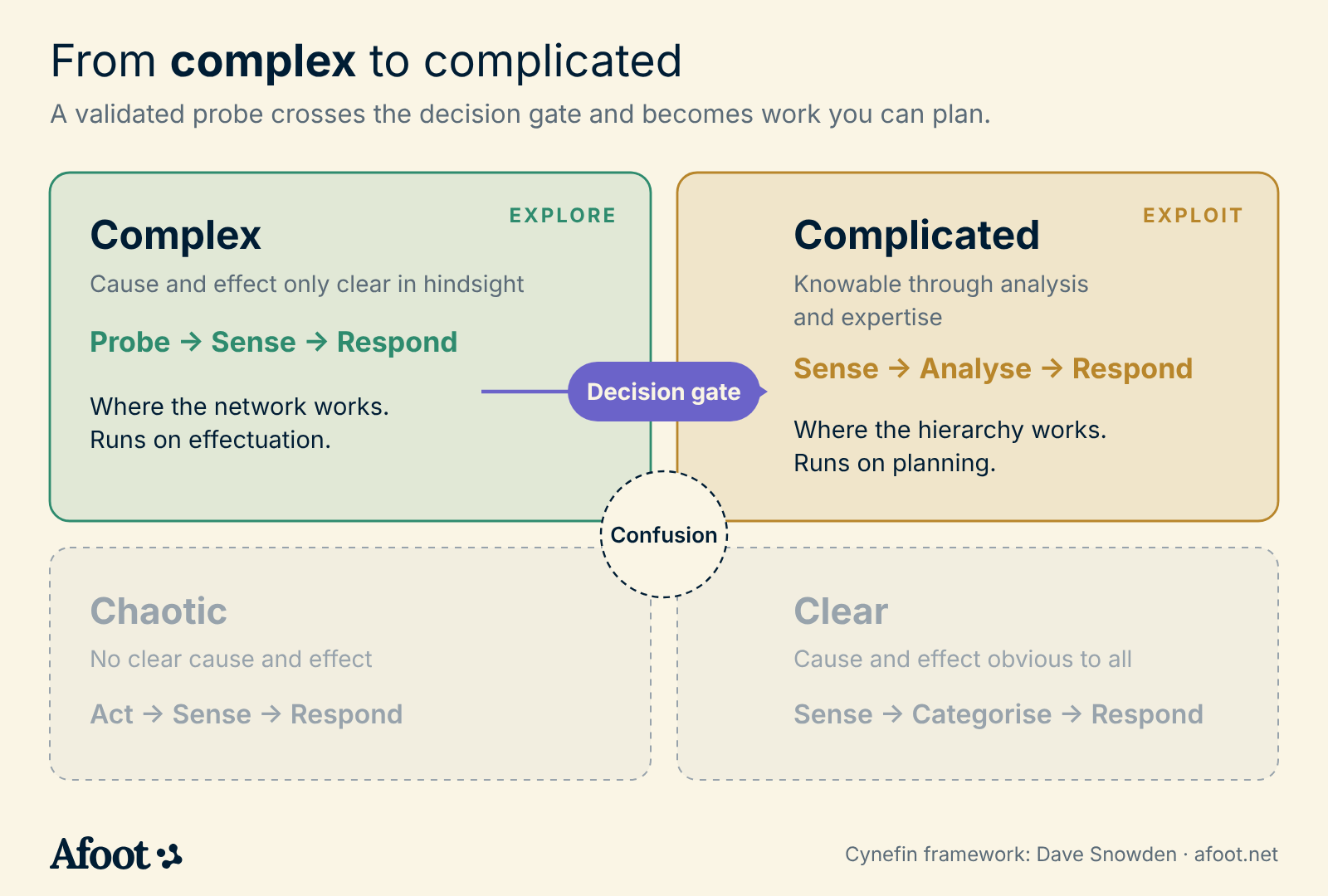
AI will increasingly handle the complicated. The work that remains for humans is the complex work: navigating ambiguity, making tradeoffs, committing under uncertainty.
This is where the “codifiers’s curse” hurts. The World Model improves AI agent performance on complicated tasks. Humans verify the output. The better the agent gets, the less the human matters. Then suddenly you are a quality check on a machine that is getting better at the thing you’re checking. That is a shrinking role.
“It is eroded from within as experts codify their own obsolescence (the Codifier’s Curse), converting their experience into training data”
— Christian Catalini, Xiang Hui and Jane Wu, “Some Simple Economics of AGI.”
The opposite trajectory is possible. As AI takes over the complicated, humans are freed for the work that actually requires them: coordinating with each other, through the uncertainty, to decide what matters and what happens next.
Why you can’t skip the human part
Humans aren’t pre-wired for complex coordination. We figure it out by working with the same people repeatedly until patterns form and shared understanding develops. That shared understanding is the real infrastructure of trust. It’s what lets a team of ten move faster than a team of a hundred.
The World Model assumes you can replace that with a database and a context window. But context is not trust.
When a system assigns priorities without shared understanding, it feels like a suggestion from a stranger. People treat it that way. Without the moment where people align, decide, and take ownership, the work has no weight. It doesn’t carry forward.
The best systems help you make sense of the situation and make sure decisions are clearly made, owned, and followed through. Neither works without the other.
Creators, not editors
We don’t believe a small group of people are creators (I.e. the thinking class). We believe most people are capable of meaningful judgment. But the systems we’ve built often reduce them to editors. AI will amplify that pattern. It will either concentrate judgment further, or make it easier to distribute it.
People don’t lack judgment, most systems just don’t ask for it. A system that treats humans as verification layers will get people who behave like verification layers.
The answer is not to suppress judgment. It is to structure it.
The choice
AI is forcing an organisational design choice that most haven’t recognised yet. There are two default paths.
Path one: reinforced hierarchy. AI increases visibility and control. More dashboards, more oversight. Humans become more legible to power.
Path two: centralised World Model. AI becomes the sense-making centre. Humans become inputs and execution nodes. The system decides. Humans approve.
Both paths move judgment away from the people closest to the work. And if you don’t choose, the system will default to centralisation. That is the real risk. Organisational design can quietly demote human judgment below the algoritm, while pretending to augment it.
To preserve the role of human judgment where it actually matters, we need a different path, a third path.
Not more middle management or centralised intelligence, but coordination as infrastructure. A system where decisions are made explicit, ownership is clear, and commitments are durable. Where what gets decided in rooms actually carries forward into the work.
Because the better we coordinate, the more independently we can act. Shared understanding and record of people’s commitments and decisions gives people the confidence to exercise judgment without constantly returning to the centre for direction. That is what makes distributed agency possible.
AI expands the space of possibilities. But it does nothing to ensure anything actually becomes real. That part still requires humans. The question is whether we build systems that honour that fact or not.
Most systems optimise for knowing what to do, but the harder problem is making sure it actually happens.
As AI becomes embedded in how organisations operate, the real question is not how much work machines can take on, but where human judgment belongs.
Ultimately, the advantage will go to organisations that know how to balance automation with human judgment. Knowing what to optimise and what must remain shaped by human judgment, imagination, and people thinking together.

There is a third path.
Afoot is built for organisations that have chosen it. Where human judgment is structured, not suppressed, and where what gets decided together actually survives into execution.
Afoot goes live soon and the waitlist is growing. Right now, we’re looking for a few design partners: companies where people are already exploring, where good ideas keep getting lost between the meeting and the plan, and that want the coordination infrastructure built around how they actually work.
If that’s you, email me at vanessa@afoot.net, or join the waitlist to follow our journey.