


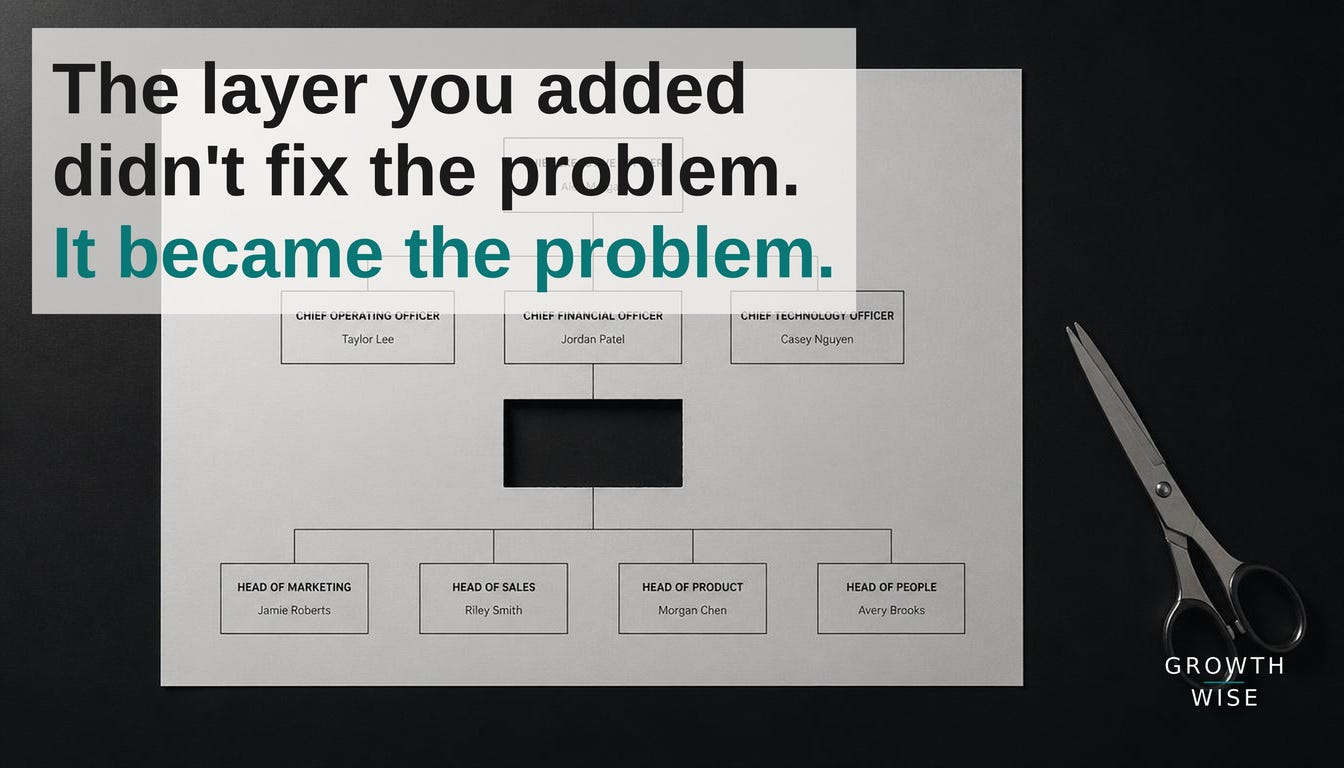
Every organization has a theory of how to fix coordination problems.
Most of them are wrong.
The default theory goes like this: things are getting complicated, people are misaligned, decisions aren’t being made. The fix? Add someone. Hire a project manager. Create a coordination role. Put a person in the middle to keep things moving.
It feels logical. It rarely works. And the reason it doesn’t work is mathematical before it’s even managerial.
Adding a person doesn’t add one connection. It adds many.
In any network, the number of potential communication channels is:
n(n–1) / 2
Five people: 10 channels. Ten people: 45. Add one “coordinator” to a team of ten and you don’t just add one link. You add ten new ones. The new manager doesn’t solve the coordination problem. They become a new surface area for it.
If the underlying system doesn’t change, the new hire spends most of their time managing the relationships their own presence created.
This is why adding management to a broken coordination system so often makes things slower, not faster. You haven’t fixed anything. You’ve made the problem more expensive.
Every layer you add is a lossy translation
Even when a manager does exactly what they’re supposed to do (synthesize information, relay priorities, keep people aligned) something goes wrong in the transfer.
A manager takes ten signals from their team and condenses them for their boss. In that condensation, the specific, awkward, important details get smoothed into something that sounds more like progress than it is. The edge cases disappear. The real blockers soften. The thing that actually needs a decision gets buried under the summary.
By the time the CEO’s strategic intent has passed through three layers of management to reach the person executing it, it has mutated into a set of KPIs that nobody finds particularly meaningful.
The distortion is structural. Every human router introduces noise. The signal degrades with every hop.
High-performing organizations don’t solve this by finding better translators. They build infrastructure that carries intent without distorting it, where the original meaning survives the trip.
The deeper problem is what layers do to the people inside them
There’s a more insidious effect that doesn’t show up in org charts.
When you add a layer of management between a person and their work, you’re sending a signal, even if no one intended to. The signal is: we don’t trust you to coordinate your own judgment.
It may be a nice manager. It may be a brilliant manager. But their presence as a gatekeeper changes how people behave. Decisions start requiring sign-off. Ideas need to be “socialized.” Ownership becomes blurry because technically the manager holds the thread.
Slowly, the people underneath stop practicing the skill of leadership. They stop asking “what needs to happen here?” They start asking “what do you want me to do?”
My friend Graziella has been watching this play out in her coaching work right now. Her observation:
burnout in these environments isn’t about workload. It’s about futility. Bandura’s research on self-efficacy backs this up. The behavior doesn’t change because people are weak, it changes because the system has repeatedly signaled that their actions don’t matter. Eventually people stop proposing. That’s not a character flaw. It’s a rational adaptation to a broken environment.
High-performing teams get built by making accountability visible and inescapable, where people can see the work, own the work, and be measured by it. That is an infrastructure problem, not a headcount problem.
The economic case is just as blunt
Managers are usually among the most expensive people in an organization. And every hour a high-output person spends updating a manager is an hour they’re not doing the work they were hired to do.
In a mediocre organization, this is treated as the cost of doing business.
In an ambitious one, it’s treated as a system failure.
The question to ask is: why pay a permanent tax on something that could be engineered away?
Complexity doesn’t get managed away. It gets engineered away. A management layer is a permanent solution to what was originally a temporary lack of clarity. Once it exists, it defends its own existence through more meetings, more check-ins, more process.
The people who’ve already figured this out
There’s a specific type of professional who has lived through this and come out the other side with a particular kind of impatience.
They’ve been in organizations where their best work got diluted by process. Where decisions they made got relitigated three levels up. Where a meeting was called to “socialize” something everyone already knew. Where “who owns this?” was a question that never got a clean answer.
They care too much to accept a system that buries signal in bureaucracy.
What they want is cleaner rules. Visible commitments. Clear ownership. A system that shows who said what, who owns what, and what happens next, so they don’t have to fight for clarity at every turn.
They’re not asking for less accountability. They want more of it, for everyone.
They show up in a few recognizable forms:
The person who has burned out in a traditional organization and is looking for somewhere their work can actually land.
The systems-thinker who looks at a tangled Slack channel and wants to redesign the whole thing.
The craft-obsessed executor who wants to spend their time doing the work, not reporting on it.
The person who doesn’t wait for a title to take ownership and just sees the gap and fills it.
What all of them share: a high tolerance for truth and a low tolerance for friction.
In most organizations, these people get called “difficult”. They’re the ones asking “wait, did we actually decide that?” and “who is the primary owner here?” They get flagged as impatient, as too demanding, as hard to manage.
They are, in fact, the most valuable people in any organization. They just need a system that matches how they think.
Clarity is a technical requirement
The tension here isn’t really between management and autonomy. It’s between two modes that every organization needs: managing for predictability (decisions, governance, execution) and leading for complexity (shared sense-making, collective judgment, experimentation).
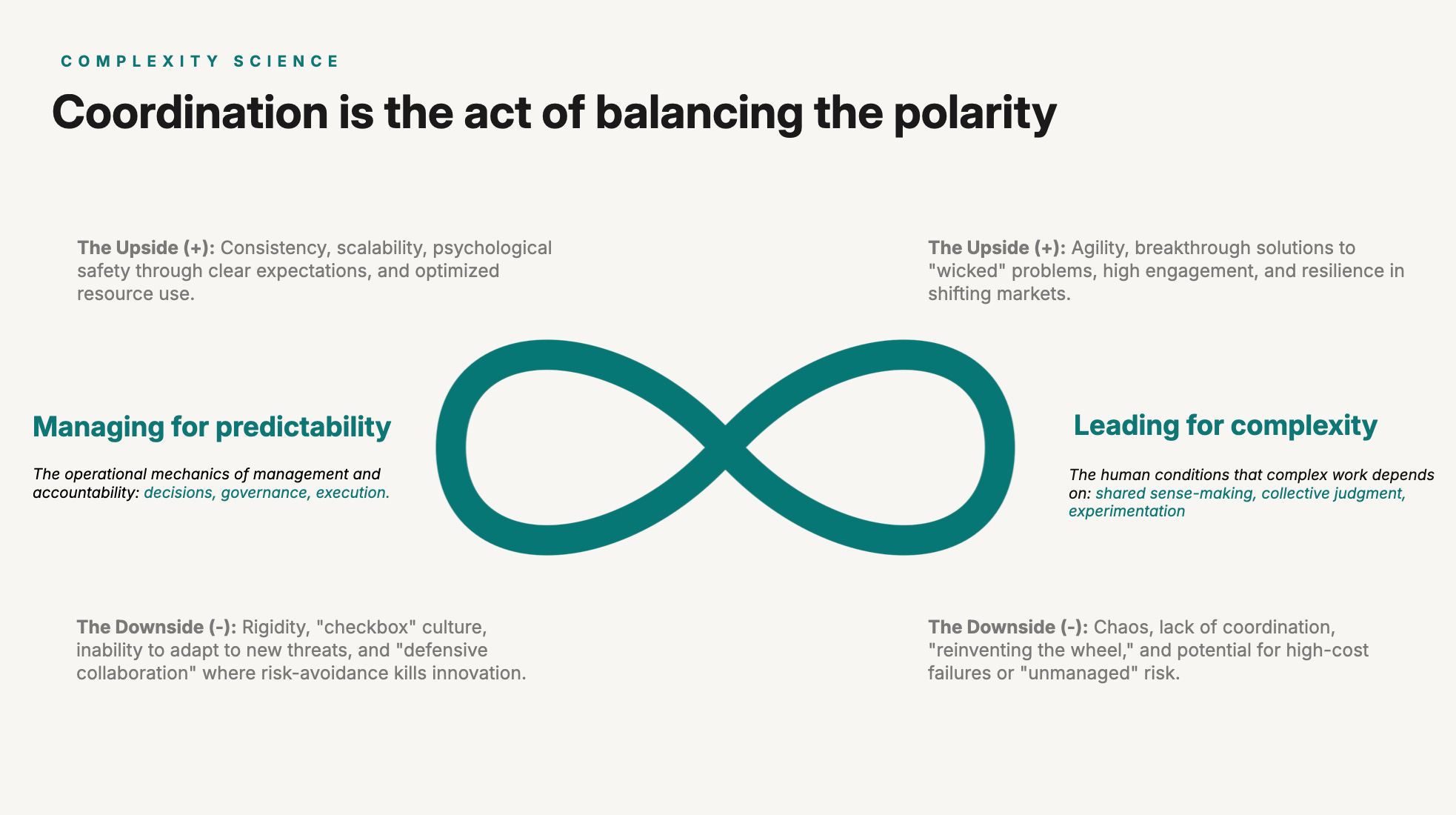
Most organizations only know how to do the first. And under pressure, they double down on it. More layers, tighter control, more reporting. It feels decisive. It looks like leadership. What it actually does is collapse the right side of the loop entirely, the part that produces agility, breakthrough thinking, and resilience in shifting markets.
The infrastructure argument isn’t about removing accountability. It’s about building the operational layer tightly enough that the human layer can actually function. When decisions, ownership, and next steps are clear and visible, people don’t need a manager to hold the thread. They can see the map and navigate themselves.
That’s what separates the organizations that move fast under uncertainty from the ones that freeze. Not fewer rules. Better infrastructure. A system tight enough that the humans inside it can lead, not just execute.
The organizations that will move fastest in the next decade will build coordination into the infrastructure itself, so that intent travels cleanly, decisions stick, ownership is unambiguous, and the people doing the work can see the full picture without asking for a briefing.
That is an engineering problem. Always has been.
And the people who’ve always known this are already looking for each other.
Growth Wise is building the infrastructure layer for teams that are done paying the coordination tax. It takes human coordination, qualifies its structural integrity, and compiles it into durable organizational reality. PM tools track execution. Growth Wise compiles coordination into executable reality.