


Humans are silly creatures. We think we approach every problem, every interaction, with a clear head, logic and objectivity. That we weigh the facts and make rational choices. But most of the time, we do not. And this blind spot is most obvious in the realm of collaboration and coordination.
In reality, we primarily interact with each other based on instinct. And that instinct is driven by our biological need to remain included in the group. The risk of social exclusion is what all of us are programmed to avoid. No one is immune to this.
It's for this reason that we offend each other without noticing, we defend our egos without noticing. We adhere to status and hierarchy without noticing. We uphold fake agreement without noticing, even when we know deep down inside disagreement would lead to better outcomes.
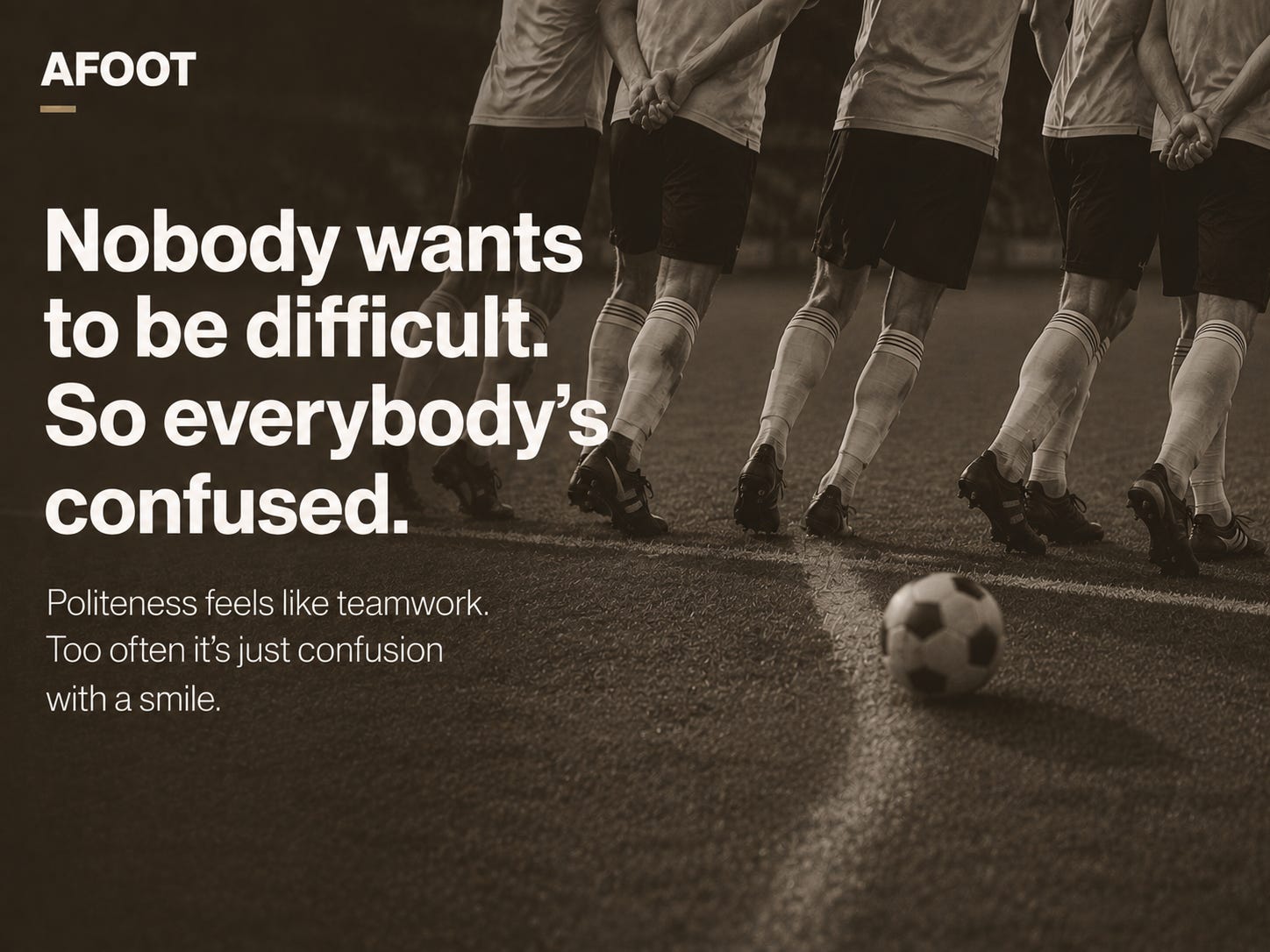
In previous eras, our group sizes were small and our pace of work slow, enough so that we could mitigate some of the damage caused by these instinctive threat responses and relational imperfections. Not anymore.
Companies got bigger, asynchronous communication tools that strip away nuance and non-verbal queues took over, execution sped up. Our tolerance for the normal friction of high quality group work began waning. Yet our dependence on the proper functioning of the collective mind did not.
Today, it often seems like we are anything but antifragile. We seem sick with abundance. Too fragile to tolerate contradictions, too weak to handle nuance, increasingly unable to think dialectically.
Or maybe that's too harsh. Maybe we didn't get worse. Maybe the conditions changed.
Dialectical thinking requires friction. You have to tolerate the discomfort of two conflicting things being true at once without rushing to eliminate one of them. Facilitators have a name for that period: “the groan zone”. The uncomfortable part of a discussion where the group hasn't landed yet and every instinct says "just pick something so we can get back to work."
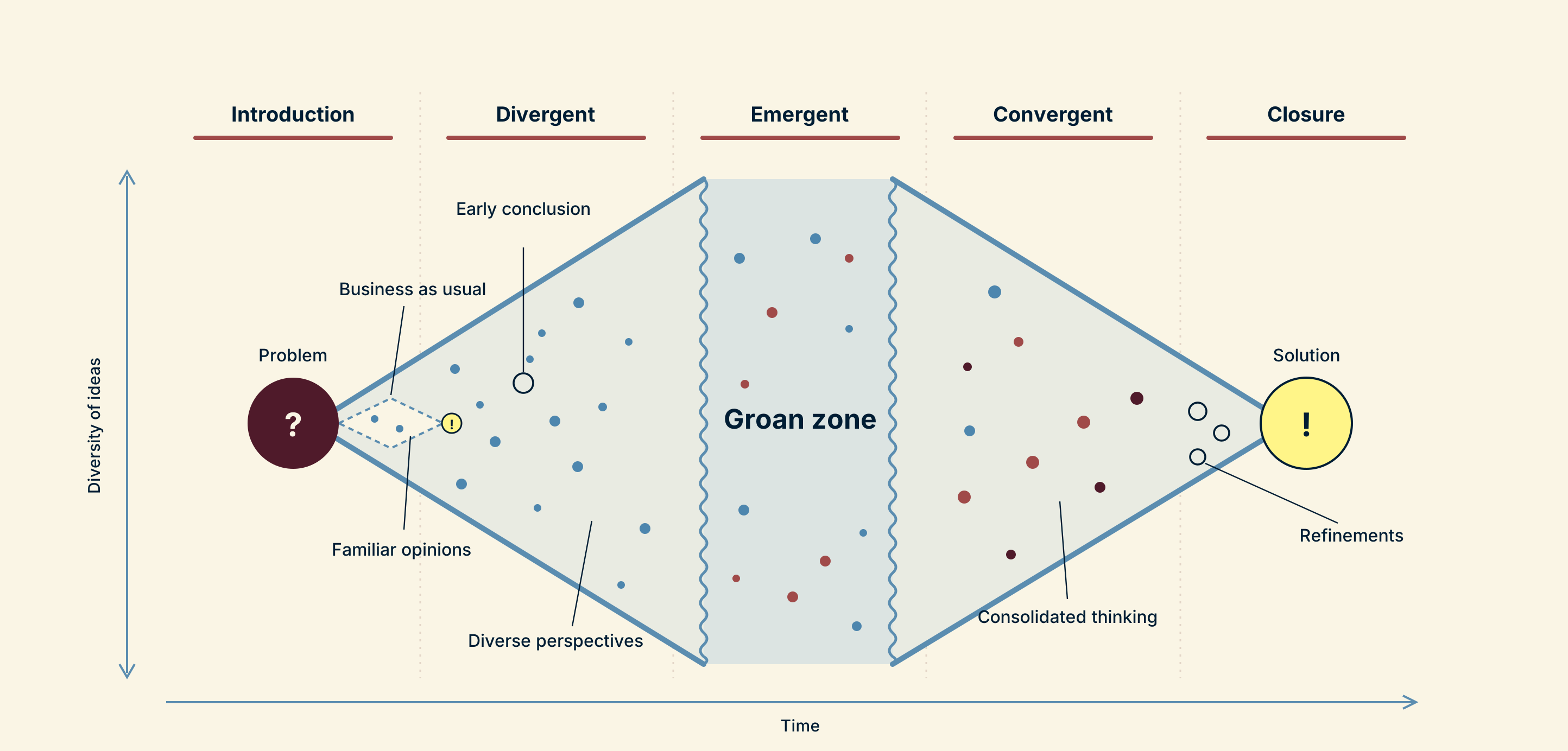
Gaining wisdom requires sitting in that zone. Innovation and progress require it too. But people will only sit in that discomfort when they are confident that what comes out of it will actually lead somewhere. Nobody volunteers for a hard conversation whose outcome disappears when the conversation ends. When decisions don't stick and accountability is vague, avoiding the friction altogether isn't a failure, it’s just sensible math.
We've gotten very good at removing friction. I'm less convinced we've gotten better at living and working collectively. A little friction is the price of a vibrant, high performing team.
It's not surprising that most of the innovation in AI is geared towards optimising the individual. Solo work has no friction, so that's where AI went first. Making each person capable of executing what used to take a team of ten. On the surface, there is nothing wrong with this. Each of us getting more productive is a great thing, but not at the expense of the collective mind.
And here is what all that individual acceleration adds up to: the cost of doing collapses, but the cost of deciding skyrockets.
More output means more decisions, more handoffs, more parallel threads. And when more things run in parallel, coordination starts to break down. Agreements and commitments fade between meetings, ownership blurs and decisions get reopened again and again. Part of the load is real and necessary. Bigger, more complex systems genuinely need more coordination. But a lot of it is self-inflicted. I call this coordination entropy, and it scales with execution volume.
I may be naive, I may be overly sentimental, but to me, teamwork still makes the dream work.
So while AI is accelerating our individual productivity, I think its greatest potential is actually in how it can make us better teammates, better leaders, better human beings. It has the potential to improve the increasingly obvious bottleneck in making work work: coordination.
Because if you really step back and think about it, while our AI agents are out executing our demands, the only thing left for us to do with our time that will have any real value will be to sit in discourse with one another. To talk through trade-offs, take perspective, and co-create ideas that have never existed before. And as much as the self-proclaimed lone geniuses would like to believe otherwise, finding innovative solutions to complex problems is best handled as a group. Creativity is a social act.
Coordination has patterns. AI can read them.
AI can help turn a mediocre team with a fragile dynamic into a high-performing team with a robust and resilient way of working.
A high-quality productive conversation about how to move work forward has a structure. There is a science to it. Human coordination is a system that has predictable patterns, and spotting patterns across large messy datasets is what AI does best. Much better than armies of middle managers, at least.
I spent the better part of a year putting this hypothesis to the test. To see what would happen if I built an ontology based on the best practices in facilitation, group development and organisational design, plus a harness to run LLMs against it, and augmented it with my 15+ years' experience leading teams through uncertainty.
What I found out was pretty impressive. Not only could AI accurately predict potential coordination failures and recommend ways to improve, but the teams and leaders I tested it with were surprisingly receptive to this type of AI-mediated intervention. Which makes sense, when you remember where we started.
Coordination failures happen without us noticing. You can't fix what you can't see, and you can't see it from inside the moment. Watching the replay of how they coordinated changes that.
I saw first-hand how the teams behaviour changed in the flow of work. There was no need for leadership courses, no expensive coaching, no massive organizational restructuring. Only a replay of how the team actually coordinated and specific suggestions on how to improve.
Since those early proof-of-concept tests, I've been joined by an incredible technical co-founder - John Sjölander . A former whizz kid turned VC, back at his craft after a ten-year hiatus.
What a time to be alive!
Coordination infrastructure for high-performing teams
Together John and I are building Afoot: AI that turns human judgment into coordinated action. It processes meeting transcripts, encodes what the room actually decided, who owns what, and what's still open, and carries that context forward so everyone stays on the same page, people are held accountable, and healthy disagreement becomes easier.
How does it do that? With its own team of coordination agents, each one with its own narrow role.
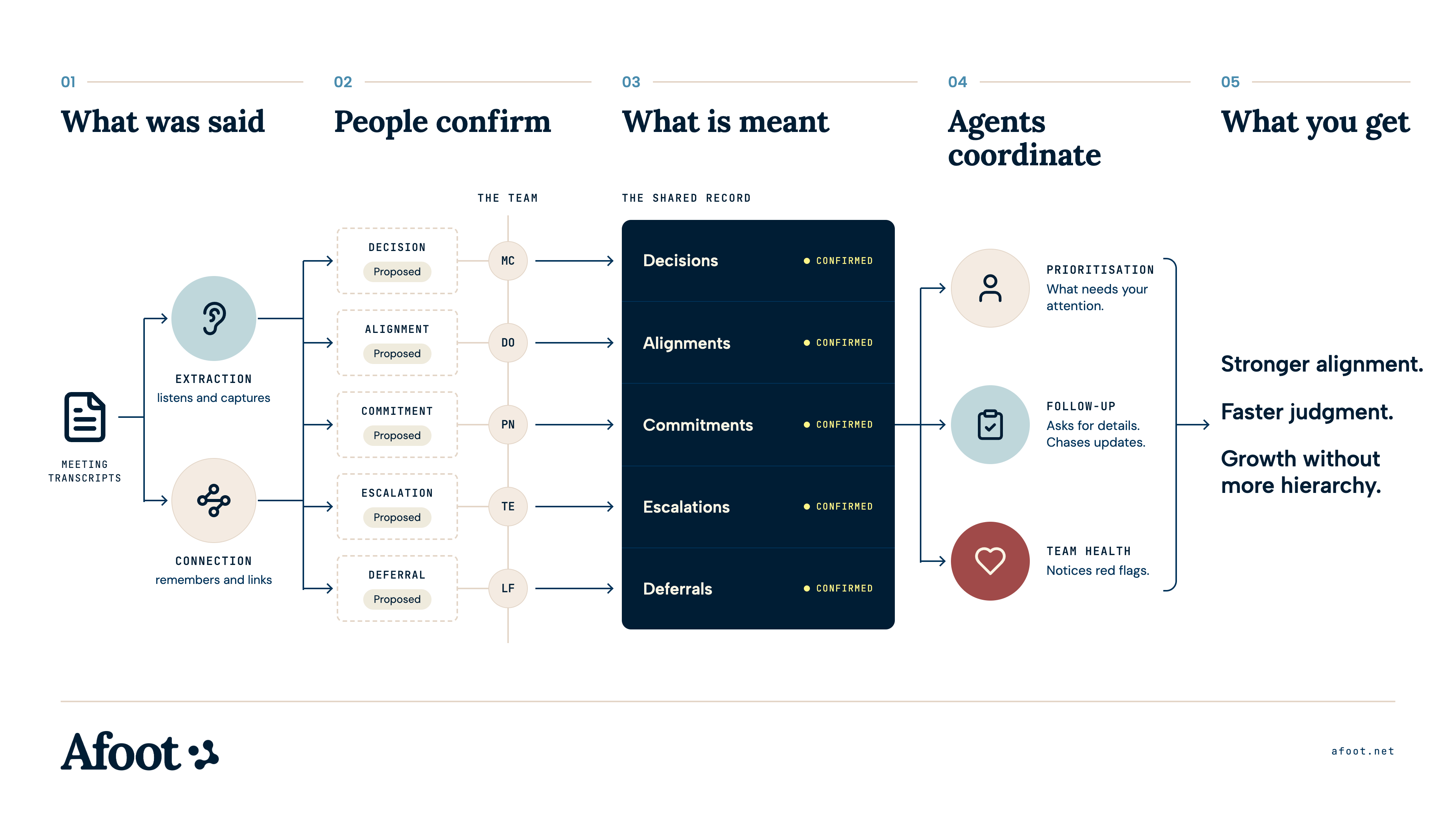
The Extraction agent listens to meetings and writes down what happened as one of five possible coordination objects: decisions, alignments, commitments, escalations, and deferrals (i.e. things to revisit later).
The Connection agent looks at every new meeting against everything that came before it. So a decision from three months ago and a decision from today get recognised as the same thread. It also maps new coordination objects to existing initiatives, making it easier for everyone to see how work is being coordinated within a given frame.
The Prioritisation agent collects everything scattered across meetings (including those you didn’t attend) that actually needs your attention: things to confirm, commitments coming due, issues bumped back for a conversation. It pulls them into one ordered pile and keeps it current. It also keeps track of what others owe you, and tells you when a commitment you were counting on got fulfilled, withdrawn or blocked, so you can adjust accordingly.
The Follow-up agent stands back and reads the whole coordination ledger. Which commitments are blocking others? What’s overdue? Then it follows up with the right people for updates and drafts a suggested agenda for a meeting or discussion. This is so issues potentially blocking coordination can be addressed immediately instead of accumulating complexity.
The Team Health agent keeps an eye on the softer side of how the team works together. It catches unhealthy team dynamics while they’re still creeping in. Like disagreements that never get resolved, increasingly levels of escalated topics, or open work piling up on one person. When it spots a pattern like that emerging, it flags the change to the leader.
What does it take to get started with Afoot
Afoot is designed based on two fundamental principles:
People interact with each other intuitively, and will continue to do so until the end of time. We can’t achieve group flow when distracted trying to adhere to some rigid decision making rubric or feedback framework. Let people be people. Collaboration got us this far. The only thing that has changed is the pace and complexity of the challenges we face, and the pull of the devices making it harder for us to focus on the conversation in front of us. Humans aren’t the problem. The lack of infrastructure is.
People are at the limit of their cognitive bandwidth. If Afoot is going to help unlock the power of the collective mind, it cannot require a major learning curve. Record the meeting. Then, when the pile of coordination objects arrives shortly after, either accept, edit, or reject. That's the whole job. If the meeting itself was of any value, a few minutes of reflection afterwards is a small price to pay. The alternative is having the exact same conversation again and again because everyone walked out of the room with a different interpretation of what was discussed.
That’s all Afoot requires of its users: hold higher quality conversations. Record them. Confirm what you understood afterwards. And trust Afoot to do the rest.
How Afoot makes AI agents flow
Since every coordination object, extracted from live dialogue, is confirmed by the people in the room, every agent downstream can now act on that reality. That's what makes it finally safe to let agents move fast with greater autonomy. Because every significant decision an agent takes is traceable back to one or many humans who agreed to be held accountable.
When agents can do more autonomously, this leaves the people to have the discussions, disagreements and debates earlier and more often.
The normal friction of high quality group work stays, and that is the whole point. Afoot simply makes sure something useful comes out of it. The “groan zone” becomes worth it again.
We’ve all been in a discussion where it clicked. Where you left the room thinking: that was worth the time. You know it's possible because you've felt it. It's just so rare it feels like luck.
It doesn't have to be luck. As AI agents will take on more of the production work, what’s left for us is the human part: talking, disagreeing, changing our minds, figuring things out together. Those moments have to be worth showing up for.
We don't need AI to remove the friction of being human. We need it to help us make better use of it.
Build the infrastructure with us
Afoot goes live soon and the waitlist is growing. What we’re looking for now is the right design partners: a few companies that feel the pull towards working this way and want the coordination infrastructure built around how they operate.
If that’s you, email me at vanessa@afoot.net, or join the waitlist to follow our journey.

There are systems thinkers, and then there are living-systems thinkers. I knew they were all on Substack!
This is so fucking cool. I'm excited to see where this thinking goes! Very glad @organizationalgravity recommended you, Vanessa. 🥰