


About six years ago my sister approached the family, as well as the partners at her law firm, about setting up a scholarship together with The Canadian Caribbean Association of Waterloo Region (CCAWR) for young legally-minded talent of Caribbean descent. She wanted to create it in honor of our grandfather and great grandfather. Both of whom were lawyers, one of whom was a signatory to the Haitian constitution.
She set this in motion exactly three years before she found out she had cancer, and six years before she died.
Since her passing, I’ve had some time to reflect on her decision to do this. What that said about her, about leadership and the legacy we leave behind. What was truly unique was that she didn't wait until she was sick to do this. And she didn't put it in her own name. Although no one would have faulted her if she had. Instead, she made a deliberate decision to do something positive and good for the world then and there, well before she understood the impact that decision would have on her legacy.
What she did, in my opinion, was demonstrate the qualities of a real leader.
You see, real leaders don’t need to focus on their personal legacy. They don’t obsess about the standards by which they will be judged long after they’re gone. They focus instead on the present. The positive impact they can have on others while they still can.
Real leaders focus on generativity, not legacy.
Generativity is the work of empowering others. Legacy is simply what occurs when the things built by that generativity continue to function after the person is gone. The goal of generativity is to make oneself unnecessary, not to remain meaningful. It requires the creator to relinquish control, to let successors decide what it means, and to let the next generation change or overwrite it to suit new realities.
By setting up the scholarship in our great grandfather’s name, my sister was acting as a steward of his legacy. She wanted to ensure that he was remembered. She believed she would have decades of life ahead to witness its impact from the sidelines. For her, it was a forward-looking investment in the next generation of law students. A profession she believed in, and was absolutely exceptional at.
And therein lies the paradox; you cannot truly build your own living legacy. You can only act generatively, and entrust the actual building of legacy to the people who survive you.
Your legacy is built by those who are touched by your generativity.
What generative leaders do
The generative leader does not seek to dictate what the next generation of leaders will do, they aim to ensure their successors have the resources and infrastructure to figure it out themselves.
Here are a few key characteristics of a generative leader. Some traits to help you spot them in the wild.
They don’t push rigid rules and process. Instead they build a platform for participatory decision making. They want their successors to be able to tackle systemic challenges without needing a single visionary at the top.
They normalize dissent. They deliberately build a culture where staying silent feels uncomfortable. This allows the remaining team to evaluate new information objectively rather than defending the old regime’s point of view.
They view the organization as a complex, evolutionary system. They know trying to control the future from the top down, or from beyond their tenure, is a losing battle against complexity. Instead they build resilient teams where authority is pushed to the edges, and ensure the team has the autonomy and the coordination infrastructure to thrive long after they move on.
The impact of generative leadership
Since her passing three years ago, the stewards of her scholarship, which include the amazing team at Strigberger Brown Armstrong (SBA), our family and her husband, have continued to steward it successfully. And it is thanks to her generative leadership style that we do so every year with great joy. She didn't leave behind a rigid rubric. We each argue for our own picks, with respect and openness. We coordinate as a steering committee with little friction. And the final decision goes to her firm.
We look forward to it every year. Reviewing the candidates is a chance to be generative ourselves. It's also a reason to come together and think about her, and about who she was as a lawyer, a sister, a daughter, a wife and a friend.
When she passed away in 2023, her firm worked with the CCAWR to establish a second scholarship, this one under her own name. She never asked for it and she never would have. It exists because of what she did for the people around her while she still could.
That’s the whole blueprint. And it's an oblique one. You don’t build your own legacy. You can’t. You act generatively, and you trust the people you empowered to decide what it meant.
The Caroline Meyer Riley Memorial Scholarship
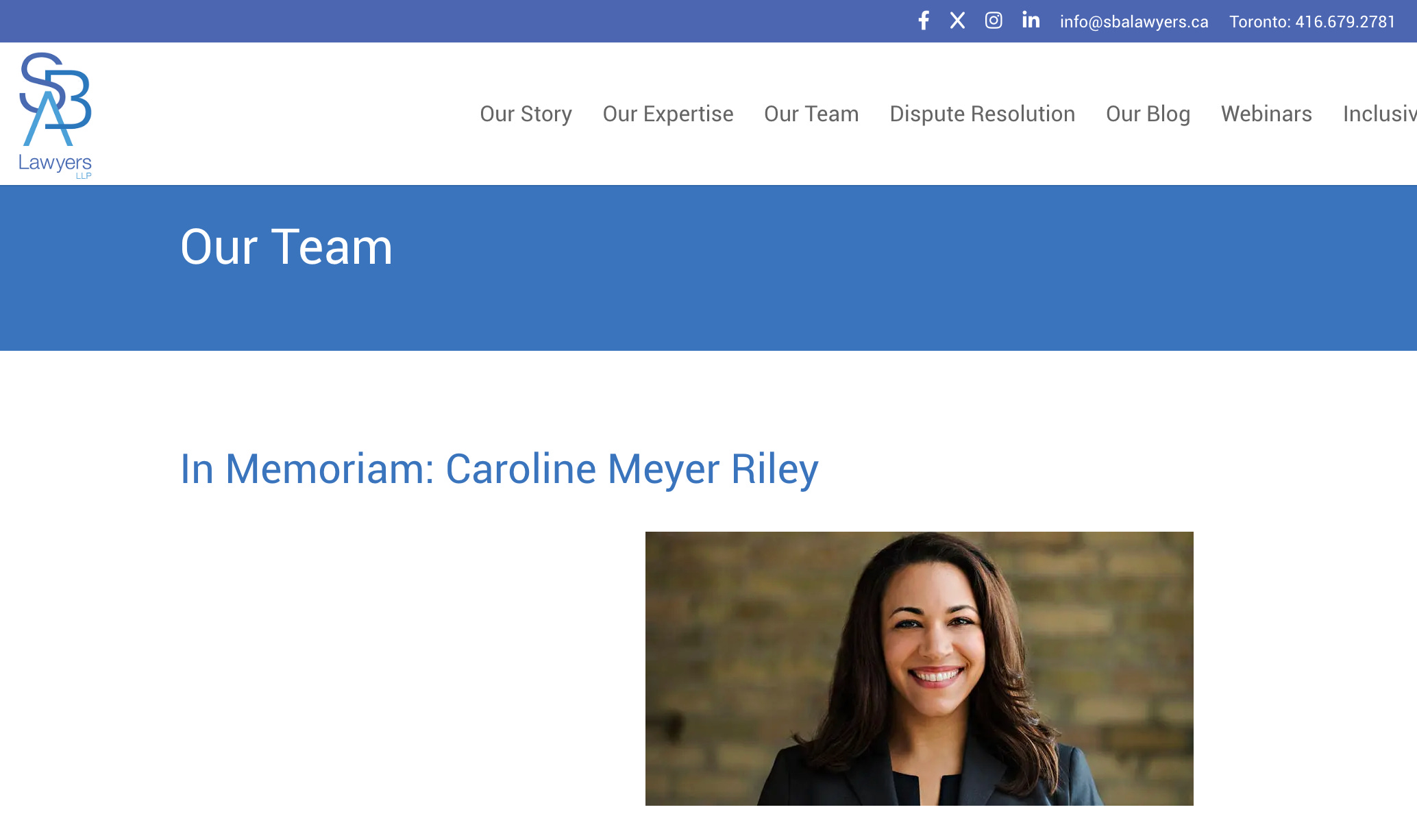
The Caroline Meyer Riley Memorial Scholarship is named in honour of Caroline Meyer Riley, who was the great granddaughter of a very distinguished Haitian lawyer Delabarre Pierre-Louis. Caroline in her own right was an exceptional and tenacious lawyer. She was one of the founding partners at Strigberger Brown Armstrong (SBA) and played an instrumental role in shaping the firm’s success. This CCAWR scholarship may be awarded to an individual who demonstrates strong community service and has an interest in law, civil rights or social justice issues. The scholarship award is valued up to $2,000.
❤️