


I’ve spent 15 years as a GTM and marketing strategist for startup and scaleup SaaS. And for 15 years I’ve encouraged founders to have a bold point of view — something that resonates with some people and alienates others. A position, not a positioning statement.
Now I am that founder, and I need to take my own advice.
With the caveat that I’m always open to changing my mind. This is where I stand today.
The cost of execution is approaching zero. The cost of knowledge is already there. Everyone will soon have the same facts, the same procedural know-how, the same ability to ship fast. Execution efficiency becomes table stakes. What can’t be commoditized is judgment: the ability to look at genuinely ambiguous situations, weigh competing perspectives, and decide.
That’s where humans still have a real shot. But only if we’re willing to do the hard part.
Dave Snowden’s Cynefin framework distinguishes between problems that are complicated and problems that are complex. Complicated problems have right answers, they just require expertise to find them. AI is genuinely good here. Complex problems are different. Cause and effect can only be understood in retrospect. There are no right answers, only bets. The right management approach is to probe, sense, and respond: run experiments, read what emerges, and adapt. This is the domain where most consequential organizational decisions live, and it’s the domain where most teams are least equipped to operate.
When the problem is uncertain, the tradeoffs are real, and the path forward requires actual perspective-taking and debate, AI struggles. It lacks what philosopher and cognitive scientist John Vervaeke calls perspectival knowing and participatory knowing: ways of understanding the world anchored in having a body, a history, a stake in the outcome. They’re social in nature. You can’t train them out of a corpus.
What makes complex problems hard isn’t a lack of information. It’s that getting to a decision requires groups to move through what facilitator Sam Kaner calls the Groan Zone: the uncomfortable stretch between divergent thinking (lots of ideas, competing frames, no consensus) and convergent thinking (shared understanding, a direction, a decision). It’s messy. People get confused and impatient. Conversations seem to go in circles. Someone usually tries to short-circuit it by calling for a vote, or defaulting to HiPPO (highest paid person’s opinion) in the room.
Most groups will do almost anything to avoid the Groan Zone. Anything that lets them feel like progress happened without sitting in the discomfort of not yet knowing.
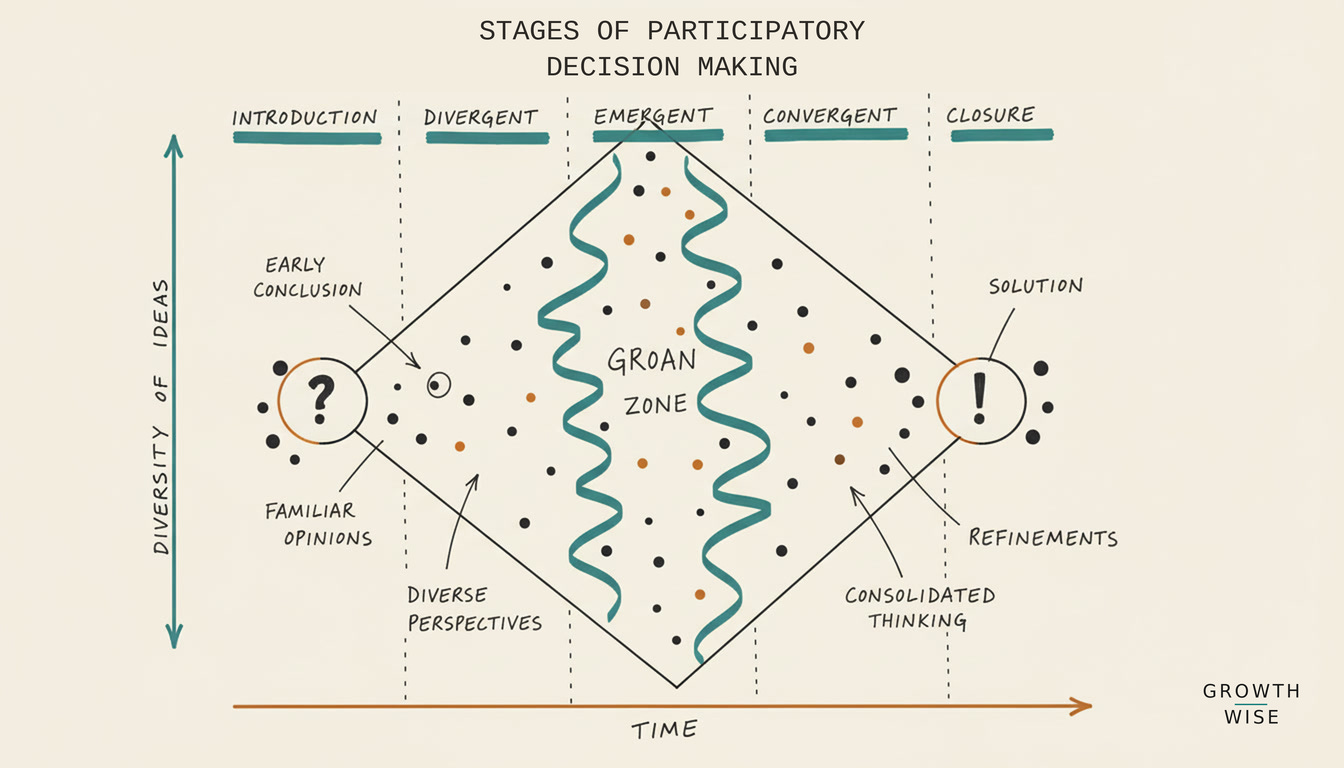
The conditions for navigating that discomfort are getting worse, not better.
More white-collar work is now done remotely. And while remote work gets framed as a coordination problem, the deeper loss is perceptual. In a room, you’re reading the whole space. Who shifts in their seat when a topic comes up. Who makes eye contact with whom. The pause before someone speaks. Video strips most of that out. You get a grid of faces, degraded audio, and none of the spatial and temporal cues that tell a group how the room is actually feeling or who’s about to speak. The brain works harder to compensate, and still misses things.
At the same time, the teams most likely to produce something genuinely new are diverse ones. Diverse teams make better decisions than homogeneous ones. They also find it harder to reach consensus. More friction, more misreading, more moments where different communication norms create confusion. The Groan Zone is longer and more treacherous when the people in the room don’t share context.
So we’re asking more of our collaboration — more complexity, more diversity, more distributed — while giving it less to work with. Remote removes the cues. Diversity increases the friction. And the communication skills required to navigate all of it are getting weaker.
I see no evidence that our capacity to hold our attention long enough to think together is improving. Let alone our ability to communicate without trolling each other or becoming combative.
So we schedule another meeting. And another. Not because we’re inefficient —because the work is genuinely hard and we haven’t finished it yet. Add the politics layered on top: the very human instinct to avoid being the person who made the wrong call, to stay aligned with the group, to not be the one holding up the decision.
Uncertainty is uncomfortable. Social exclusion is worse.
The meeting becomes a place to keep moving without committing, to feel like you’re still in the room. Communication has eclipsed creativity as the central skill of white-collar work — and we did it to ourselves. No wonder we’re drowning in alignment meetings that don’t actually align anything.
Fewer meetings is part of the answer. The bigger part is making the ones we keep count for far more than they currently do. Right now most of them leave no legible record of what actually happened.
Meetings multiply because decisions don’t close. When a decision doesn’t close, the same conversation reconvenes. When ownership isn’t assigned, people keep gathering to re-establish it. Often what’s really happening is that the group hit the Groan Zone and retreated — scheduled another meeting rather than push through to something real. The calendar is downstream of that failure, not the cause of it.
The meeting is where negotiation actually happens. Where someone says “wait, I thought we were doing X” and it either gets resolved or gets papered over. Where accountability is accepted in real time or quietly avoided. Where the group’s actual coordination logic becomes visible. That signal doesn’t exist anywhere else. Not in the Slack thread, not in the task tracker, not in the shared Google doc.
As AI absorbs the predictable and the analytical, meetings become the last place where human judgment is live, negotiated, and legible. We should be holding that forum to a much higher standard than we currently are.
That’s what I’m building as founder. I’m treating meetings as the diagnostic signal they actually are.
I hold this view for a reason that has nothing to do with research.
I’ve spent most of my career being hired to drive growth with virtually no resources, bringing to market products no one had seen before, from brands no one had heard of. With cash runway of maybe six to twelve months. Sometimes less. Whatever choice you made had to work, because there wasn’t a second one.
In those conditions you can’t relitigate decisions. You can’t ask for more data. You can’t wait for full alignment before moving. You have to get a room full of people — many of whom never saw the problem as theirs to solve, engineers who had never thought about go-to-market, product managers who figured sales was someone else’s department — and somehow get them to think together, decide with conviction, and move.
That was never a meeting problem, it was a coordination problem under fire.
The best solutions I’ve ever been part of came from groups that managed to do exactly that. Not because they had more information or more time, but because they got into the Groan Zone together and came out the other side with something real. An idea nobody walked in with. A decision everyone actually owned.
We did it in the time and with the resources most large companies would spend trying to align everyone’s calendar for the meeting and ordering the snacks.
That’s fifteen years of being taught, expensively, that the quality of how a group thinks together is not a soft skill. It’s the variable that determines whether a company survives long enough to find out if it had a good idea.