


“Don’t let parallel brilliance become org entropy”
—Nathaniel Whittemore, The AI Daily Brief
At AI-native companies, every job is becoming a startup.
A BCG study of the companies furthest ahead with AI found just under two-thirds have removed procedural permission gates, and about half pushed decisions further down the hierarchy. Three-quarters now judge success by the quality of judgment, not the volume of activity.
Inside these companies, work looks different:
Work is shifting from executing to framing the problem and setting the objective.
Roles are blurring as people assemble around problems rather than org-chart positions.
People take on more ambitious work, because a bold attempt costs less than ever.
And instead of approval chains, companies build-in governance, access, versioning, and conventions into the system, so everyone can move faster with less risk.
And it seems to be paying off. Another BCG Institute study found that companies redesigning work and talent around AI, rather than layering AI tools on top of old approaches, outperform their peers by more than 11 percentage points a year in industry-adjusted shareholder returns.
And it isn’t confined to product development. Across these companies, people in every function are asking some version of the same question: “what can we do now that wasn’t possible before?”
PwC’s 2026 Hopes and Fears survey of nearly 50,000 workers shows who these people are. They are the “front-runners” with scarce skills and strong AI capability. They’re far more likely than average to say they’re rewarded for using AI effectively and for challenging how work gets done. They’re also less focused on avoiding mistakes. A second group, which PwC calls “AI insurgents”, is the people outside scarce roles using AI to gain a strong advantage. The rest of the workforce, the engine room, is rewarded for something else entirely.

Two very different mindsets, inside the same company. About a third of workers are already behaving like intrapreneurs, the rest are keeping the business running. Both are necessary. Most organisations have no way to connect them effectively.
But the front-runners won’t wait forever for their ideas to land. Almost a third of them (29%) say they’re very or extremely likely to change employer in the next year.
So every job may be a startup, but most companies aren’t built to run hundreds of them at once. Without the right systems, the parallel brilliance of their people turns into organisational entropy.
“There are definitely moments where ‘high agency’ is just a flattering way of describing duplicated work, unclear accountability, or someone stomping on somebody else’s toes. Sometimes the chaos produces a better outcome. Sometimes it’s just chaos.”
— Elena Verna, Growth at Lovable
The problem with innovation labs
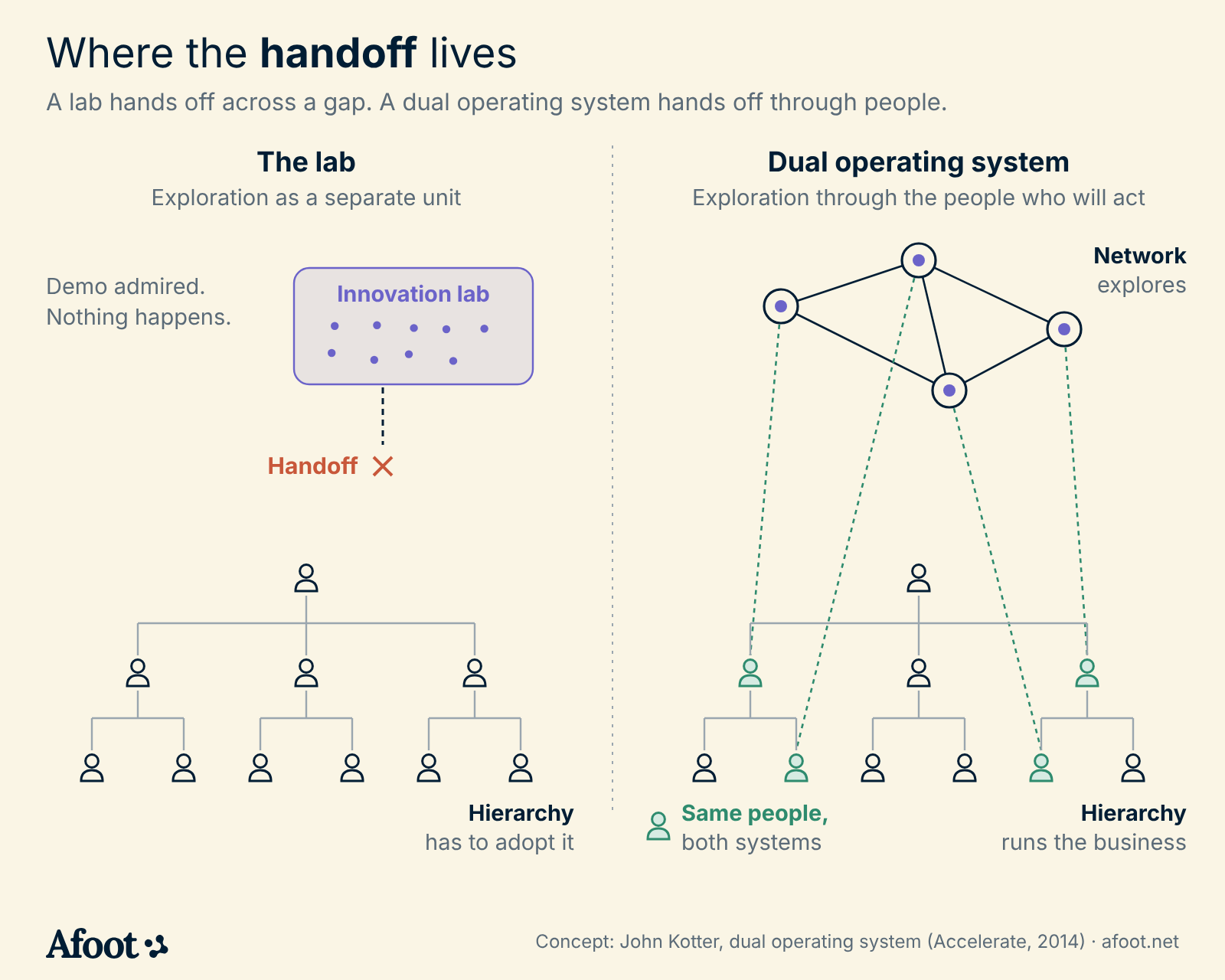
This isn’t the first time companies have tried to connect explorers with the engine room. The usual solution has been the innovation lab: a dedicated team, set apart from the business, free to experiment.
Most labs fail. They fail because they were structurally disconnected from the organisation that has to judge, adopt, resource and scale what they find through experimentation. The lab itself was never the problem, the handoff from exploration into coordinated organisational action was.
Josh Woodward, VP of Google Labs, made a similar point in a recent interview with Lenny Rachitsky on Lenny’s Podcast. Labs fail when they aren’t connected to the rest of the organisation. They build something clever, everyone admires the demo, then nothing happens. The company simply can’t absorb it.
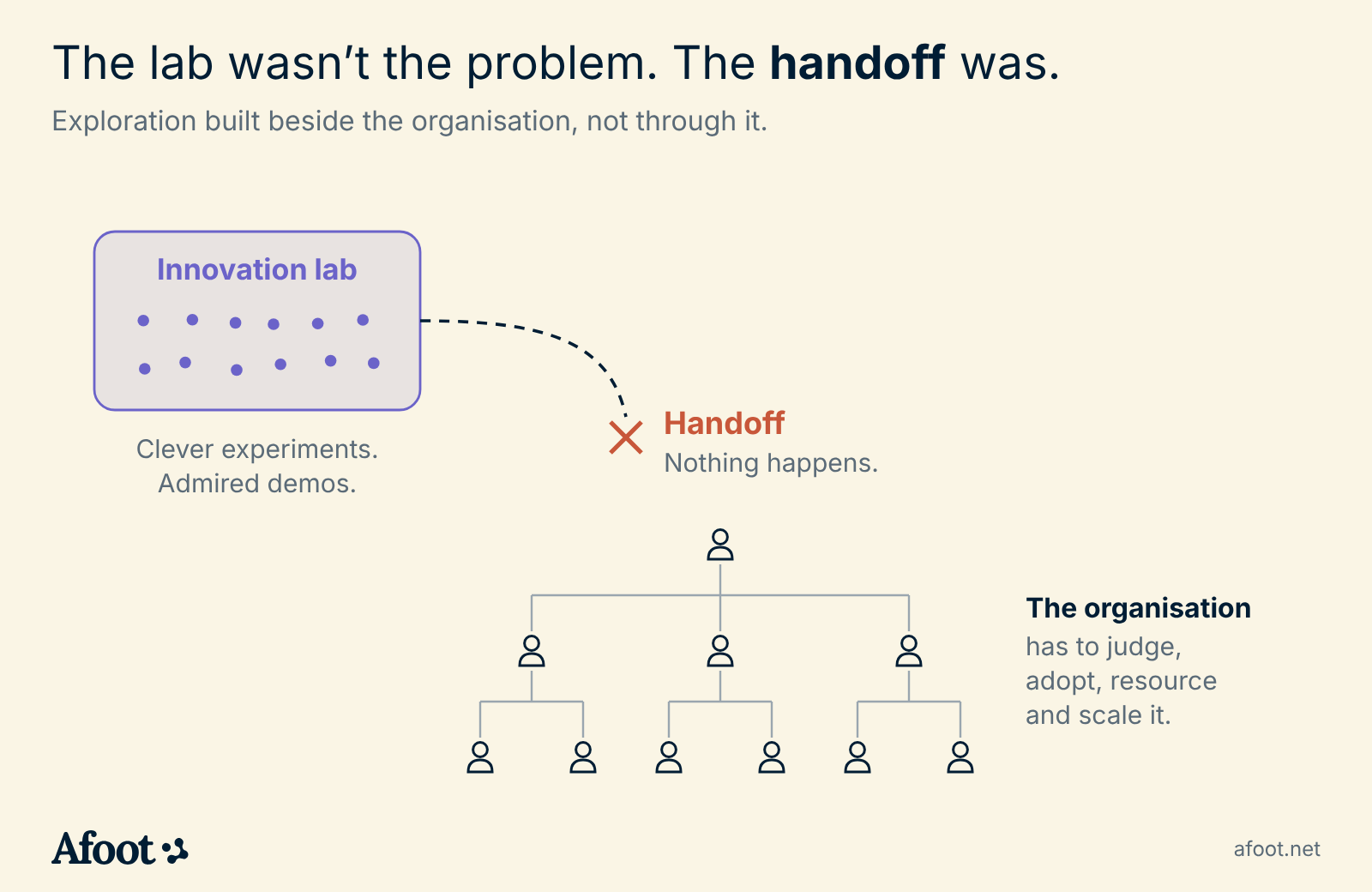
If the failure point is often the handoff, it’s worth asking what’s being handed off. Labs produce things: demos, features, prototypes. But adoption of new things doesn’t happen because a thing is good, it happens when people change what they do.
So maybe the problem isn’t the experimenting. Maybe it’s that we only know how to experiment with one kind of thing.
Towards a broader understanding of innovation
It’s not just labs. When most companies say exploration, they mean product. Innovation teams run design sprints. Hackathons end in demos. The whole vocabulary assumes there’s a thing that gets produced at the end: a feature, an app, something you can put in front of a user.
Design Thinking principles have shaped the vocabulary of that world. First you empathise, then define the problem, then ideate, then prototype, then test. It works well when there is an artefact to iterate on.
But most of what makes a company work isn’t an artefact. How we price, how we sell, how we onboard new hires, how we make decisions or structure our compensation plans. We innovate in these areas constantly. We just don’t call it innovation.
And because we don’t, we overlook the creative talent working within them. Nobody has a clear way to start their ideas, test them or decide what to do with them.
This isn’t just speculation. Larry Keely and the innovation consultancy Doblin studied more than 2,000 successful innovations to understand where breakthroughs actually come from. In their book, Ten Types of Innovation: The Discipline of Building Breakthroughs, they explain that innovation is much bigger than new products or technologies. They sort innovation into ten types: profit model, network, structure, process, product performance, product system, service, channel, brand and customer engagement. Only two are about the product itself.
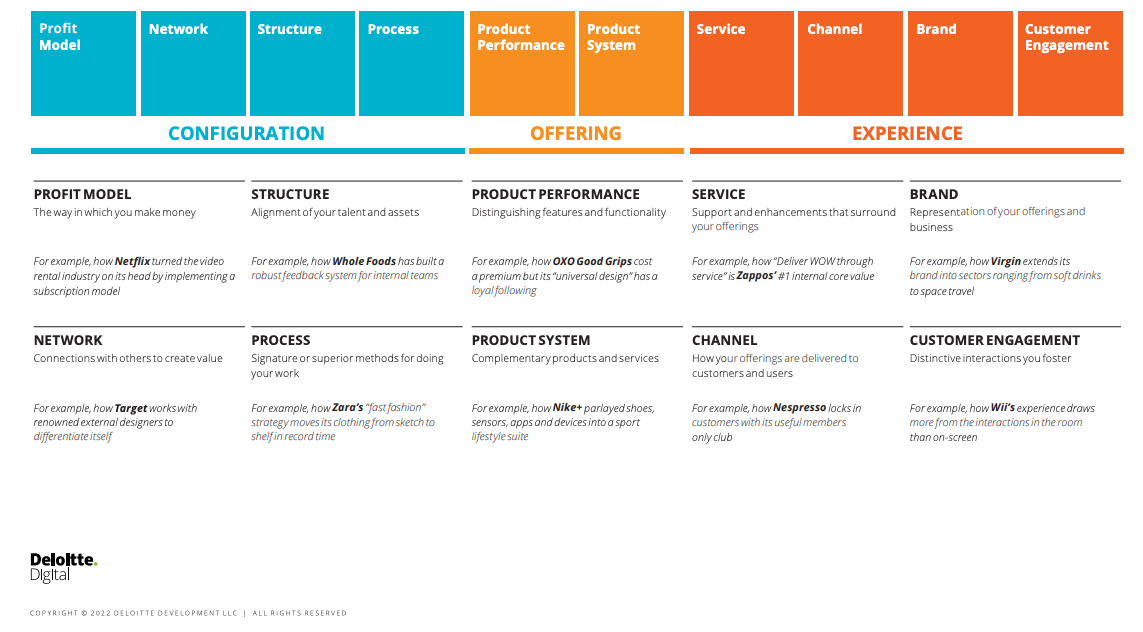
The most interesting finding is that the strongest innovations rarely rely on one type. They combine several. A new profit model with a new channel, and a new way of engaging customers, rather than competing on product performance alone.
Which means the most valuable innovations are cross-functional by nature. They need pricing, sales, operations, marketing to move together. Exactly where the handoff beaks.
AI just gave everyone a lab
Before AI, testing a new approach, running an experiment or conducting research was expensive, both in time and money. For this reason, exploration lived where the most obvious gains could be measured and validated: product performance. Not anymore.
Now a sales rep can test five pitch angles on real prospects in a week. A finance manager can model a new pricing structure in a day. An ops lead can play out a different workflow without touching a single existing process. The cost of trying something new has collapsed everywhere, not just in engineering.
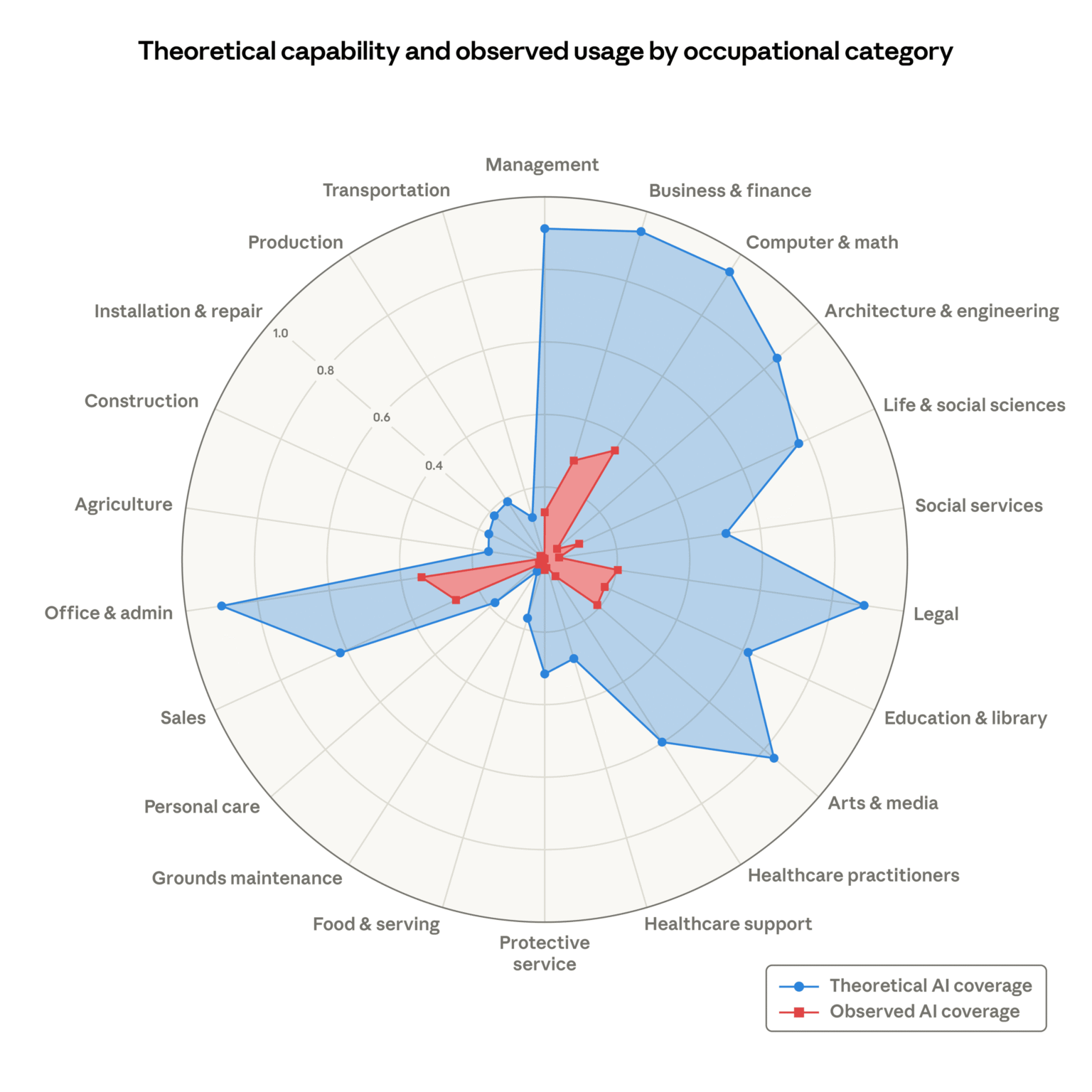
Anthropic’s research shows how early we are in this is transformation. Even in computer and math, where use is the highest, AI covers only about a third of what it theoretically could. For all other functions, the gap is wider. The capacity is already there. The exploration has barely begun.
So companies have given every function a lab’s worth of capacity, but, like a product lab, few have a method for turning all that creative output into differentiated value.
And therein lies the problem. It’s likely one reason 95% of enterprise GenAI pilots reportedly fail to deliver measurable P&L impact. Exploration gets judged with the tools of exploitation: a business case, a budget cycle, a roadmap. Most pilots never stood a chance.
The creative spark happens in every function
Everyone is capable of being creative. For many of us, school and corporate life beat it out, but look closely and you’ll see it in every function. The account manager who sees a new pattern in the way customers articulate their feedback, the finance person who spots a new way to close the month, the sales person who identifies a unique niche channel for finding leads.
Until recently, most of these ideas died in someone’s head. But AI has changed that. A spark can become a draft, a model, a working mock-up in a single afternoon.
Making something is now cheap. Making sense of it isn’t. The idea arrives looking finished, without the story of why it matters, who has to act on it or what happens next. So the work of judging it falls on whoever receives it. Multiply that across the entire organisation and the so-called “slop grenades” start flying.
“The failure case now of lazy work is not lack of output, it’s over-output […] We are all tossing slop grenades at each other.”
- Tobias Lütke, CEO of Shopify
Not all of it is slop. Some of it is a bold attempt.
And attempts are good. AI let’s people step outside their lane, and that’s often where the better ideas are. In a randomised trial with 791 professionals at P&G, people without AI stayed in their lane: R&D professionals proposed technical solutions, commercial professionals proposed commercial ones. Given AI, both groups produced balanced solutions whichever side they came from, and the quality of work improved.
AI lowers the cost of accessing adjacent expertise.
The trouble is that most organisations weren’t built for this volume. AI has radically increased our capacity to generate and explore new possibilities. Our capacity to evaluate them, coordinate around them, and turn the best ones into action hasn’t kept pace.
So new ideas either get ignored, or get pushed through the planning machine too early. They get evaluated using tools built for exploitation, not exploration. So the ideas die there too, just more slowly.
This short video below shows why AI has moved the bottleneck to alignment and coordination, and why the handoff from exploration to exploitation is harder than ever.
We get more ideas, more drafts, more demos. The divergent zone explodes. What doesn’t expand is what expert facilitator, Sam Kaner, calls the “groan zone”: the uncomfortable stretch where a group looks at all that output and decides what it means, and whether anyone will act on it. That’s the new bottleneck.
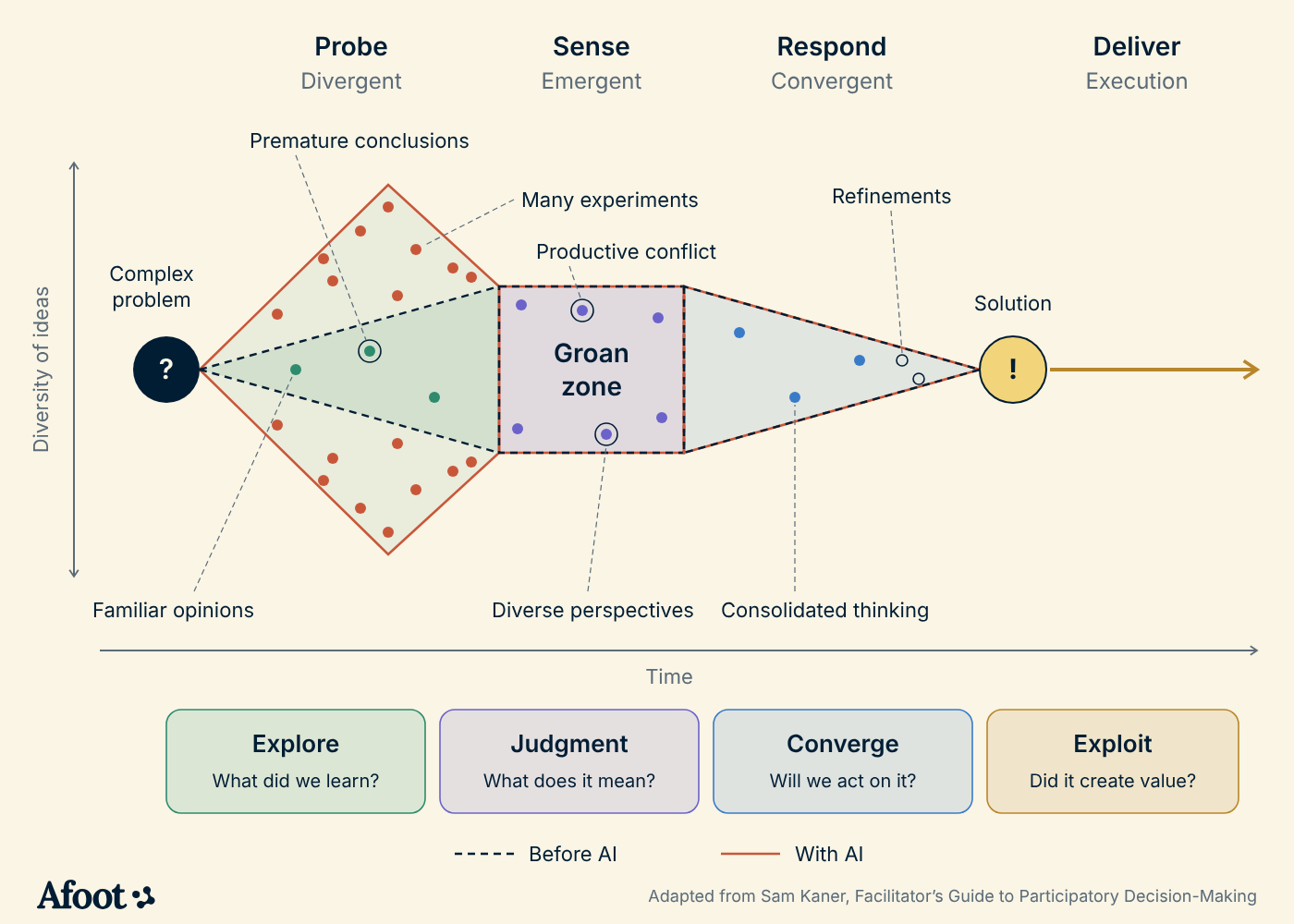
Every innovation is a plot. Some produce an object.
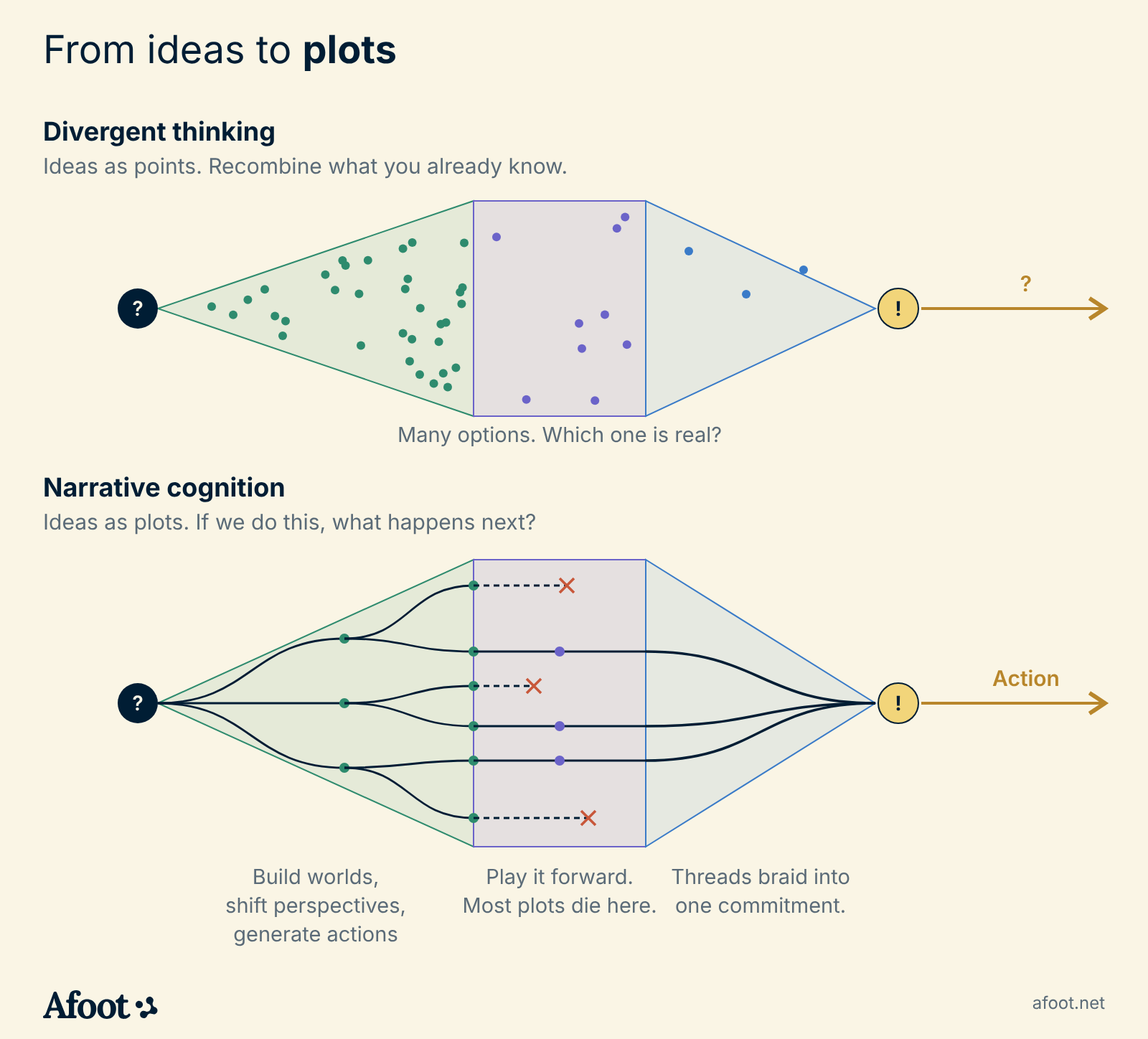
Part of the problem is how we’ve been taught to be creative. Most creativity training runs on one engine: divergent thinking. You generate lots of ideas by recombining what you already know. Brainstorming, ideation workshops, and most design education are built on it.

Angus Fletcher, author of Storythinking and Primal Intelligence, and his colleague Mike Benveniste at Ohio State’s Project Narrative, argue that this engine has a problem. Decades of training have made people better at divergent thinking tests, without the expected gains in actual innovation. More ideas do not necessarily mean more breakthroughs.
“Because divergent thinking is a computational process, it can be automated via AI. Yet, even though AI can execute divergent thinking at vastly greater scale and efficiency than humans, it has not shown improved aptitude at most creative tasks.”
- Angus Fletcher and Mike Benveniste,
“A new method for training creativity: narrative as an alternative to divergent thinking.”
And now AI can generate and recombine existing ideas at a scale humans never could. So we’ve increased our capacity for the part that was never enough on its own, and the genuinely creative ideas end up downed out by the slop.
Angus Fletcher and Mike Benveniste propose a second engine for creativity training: narrative cognition.
Narrative cognition is about thinking in actions, causes and effects. It has less to do with “what could we make?” and more to do with “if this were true, what would happen next?” It’s how the human brain evolved to act when the future is uncertain and past data only tells you what worked yesterday.
That’s the language most companies are missing. Every innovation is the plot of a story, and outside product, there often isn’t an object at all.
A new pricing model is a story. If we raise the entry price, small customers will likely churn, but the mid-market expands. If sales changes how it qualifies prospects, finance sees a different revenue curve. You can’t prototype this. You can only play it forward.
Angus Fletcher and Mike Benveniste describe three ways to train narrative cognition:
World building: something unexpected happens. Instead of dismissing it, ask: what if this is the new normal? If so, what becomes possible?
Perspective shifting: temporarily borrow someone else’s causal model: how another person believes cause and effect works.
Action generating: create a collision and simulate what happens. Introduce a new actor into an existing environment, or an exiting actor into a radically different one, and ask what actions would follow.
The more we innovation as a narrative, the easier the handoff between exploration and exploitation becomes, and the more creative ideas turn into throughput and differentiated value. Because the plot already includes the people who have to act on it. Sales, marketing, finance and ops aren’t an afterthought, they’re characters in the story from the start.
The dual operating system of innovation
If every function can now explore more broadly and more boldly than ever before, the lab can’t be a separate place. It has to be a loop. And to design that loop, you have to start with how creativity actually works.
In his interview, Josh Woodward was explicit about where his team’s best ideas come from. On walks, over lunch. In the middle of the night. While on holiday.
Anyone who loves their craft will attest to this. Creative solutions to complex problems often come when you least expect it, yet traditional organisations expect you to solve problems between the hours of nine to five, Monday to Friday, while seated at your desk, in front of your computer. This isn’t how the creative process works.
“The best ideas do not come from design sprints or planned brainstorming meetings.”
- Josh Woodward, VP of Google Labs
Creativity moves in waves, both within an individual and within a team. Someone gets a spark and goes deep - they build, test, narrow in. Others nearby see it too and volunteer to support the investigation. Someone else needs to step out, to wander, to “fuck around and find out” as my co-founder John Sjölander and I like to say.
You can’t call a meeting for Monday and say: “now we will brainstorm an effective solution to this problem”. The best you can do is align on the problems worth exploring, then ride people’s curiosity when it lights up.
John Kotter, emeritus professor of leadership at Harvard Business School, describes a structure built for exactly this. He calls it a “dual operating system”. MIT’s Edgar Schein described something similar as “parallel structures”.
The traditional hierarchy keeps running the business, while a network of people drawn from across the hierarchy explores what’s next. John Kotter calls them a “volunteer army”: the people who had the spark at 3am on a Saturday and feel compelled, almost by an invisible force, to investigate, to play it forward and see what happens to the business if it works.
The crucial detail is who sits in the network. They’re not a permanent “lab team” but rather volunteers from every level of the organisation who keep their day jobs. Which makes them the same people who will have to adopt, resource and scale what they find. And the membership is fluid. Initiatives form around a specific opportunity, run, then dissolve, and people join and leave as their energy and the work dictate.
Exploration is a different kind of work
In order for the dual operating system to be effective, the network and the hierarchy need to operate with different rules.
Complexity science and the Cynefin framework help make this distinction. Most of what the hierarchy handles is the complicated work: the known unknowns that are discoverable through analysis. For complicated work, experts primarily use deductive and inductive reasoning: they apply what’s known, generalise from what’s worked before, plan a solution and execute it. The management mode is to sense-analyse-respond.
What the network explores is complex work: the unknowns are unknown, and cause and effect only become coherent in hindsight. The answers only appear as you act. So the volunteers reason abductively, noticing what emerges and making their best guess at what explains it. They probe-sense-respond.
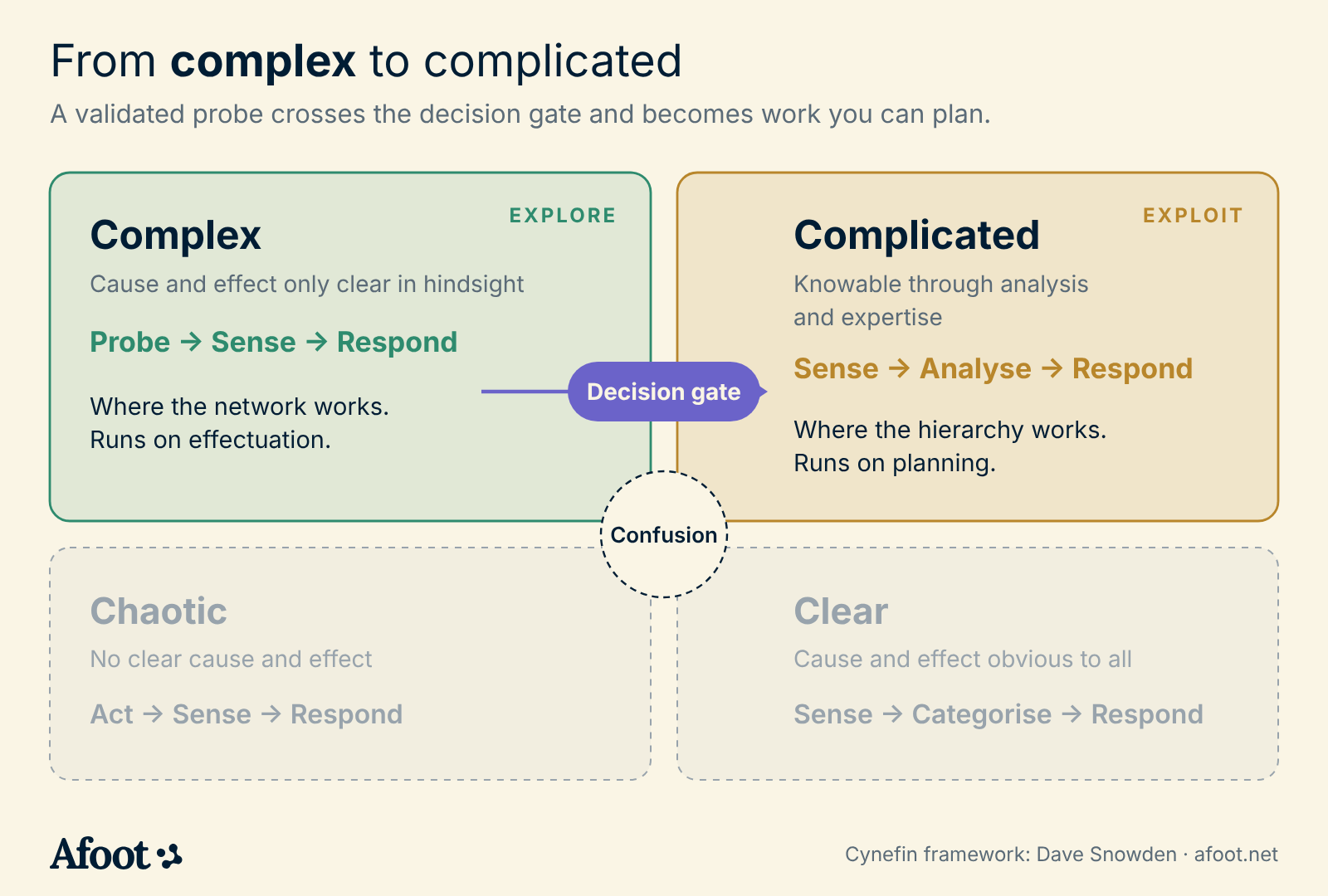
That’s why tools built for complicated problems kill the exploration of complex ones. They ask people to predict the outcome of something that can’t be predicted yet.
So how should people act when they can’t predict what will happen?
Saras Sarasvathy, professor at the University of Virginia’s Darden School of Business and one of the most cited researchers on entrepreneurship, answers this question. Her research found expert entrepreneurs have a unique way of making decisions under high degree of uncertainty. She calls it “Effectuation”, and four of its principles describe how a healthy network, and the intrapreneurs in it, behave.
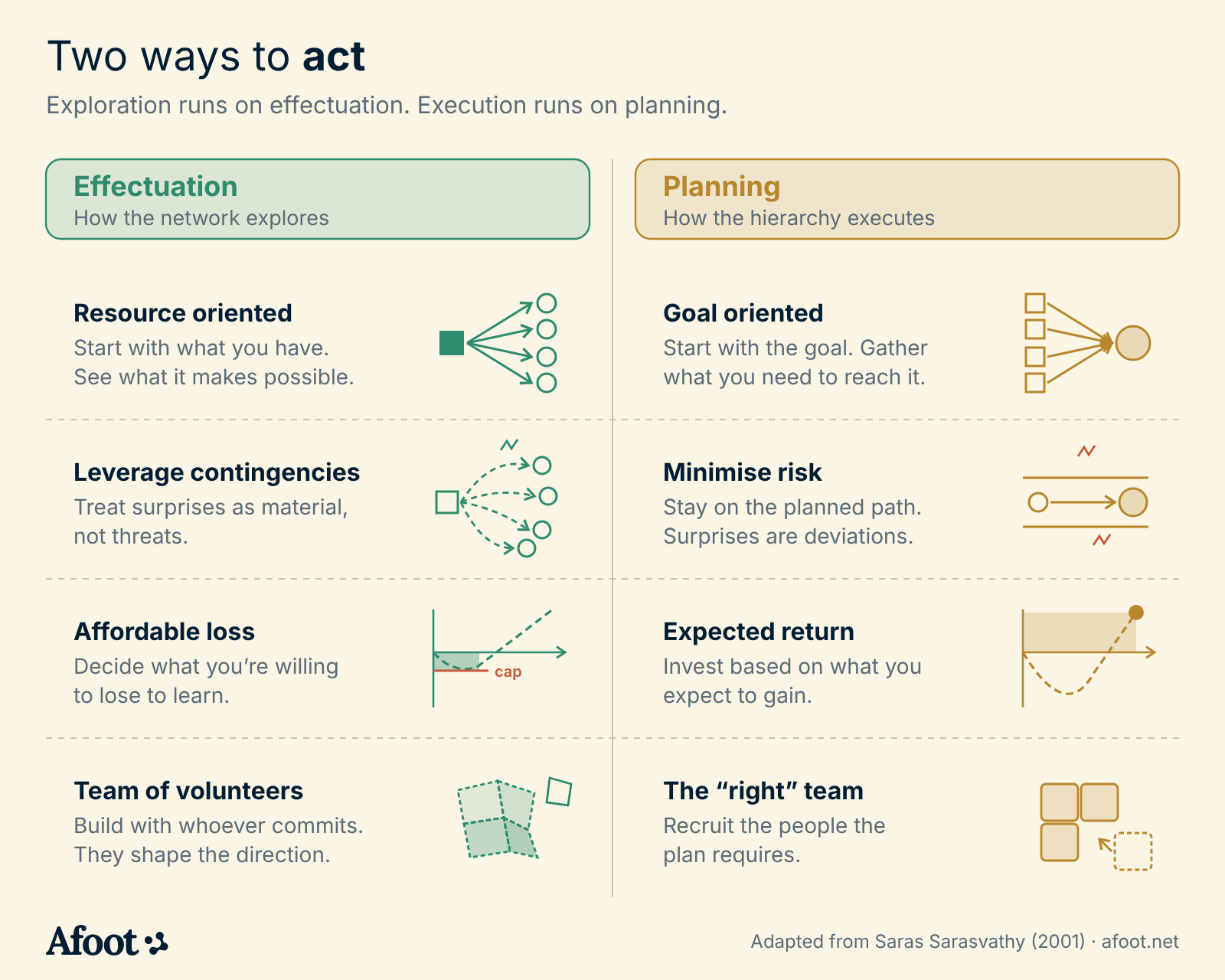
First, they don’t start with a goal and work backwards. They start with what they have and work forwards, letting the goal take shape as they go.
Second, they use surprises instead of trying to stay on the planned path.
Third, they think in terms of affordable loss, not expected returns. They know how much time, money, and reputation they can risk in order to reduce their uncertainty.
And fourth, they build with whoever commits. Not a hand-picked team of the “right” people, but volunteers drawn in by the creative spark, who shape the direction by showing up.
This is how probing works in practice. Small bets, capped losses, volunteer partners. And when a probe reveals something real, the work changes character. It moves from complex to complicated, from probe-sense-respond to sense-analyse-respond. From exploration to exploitation.
That transition is the moment most companies miss. Partly because it’s invisible.
When a probe starts working, nothing visible changes. It’s still the same people, same side project, same half-finished idea. So it either gets pushed into the planning machine too early and dies being scrutinised with a business case. Or it lingers as a side project nobody scales and nobody kills. Until eventually the volunteers running it lose interest or leave.
That transitions needs to be marked clearly with a decision. Made deliberately and out loud. It’s the moment the group says: “we know enough, this is no longer an experiment.” Or just as important: “we’ve learned what we needed to, and we’re stopping.”
That’s what a decision gate is for.
The governance loop
That’s where governance comes in. Not governances as control, but governance as connection. The point is to make sure exploration actually reaches a decision.
Here is what this governance loop looks like:
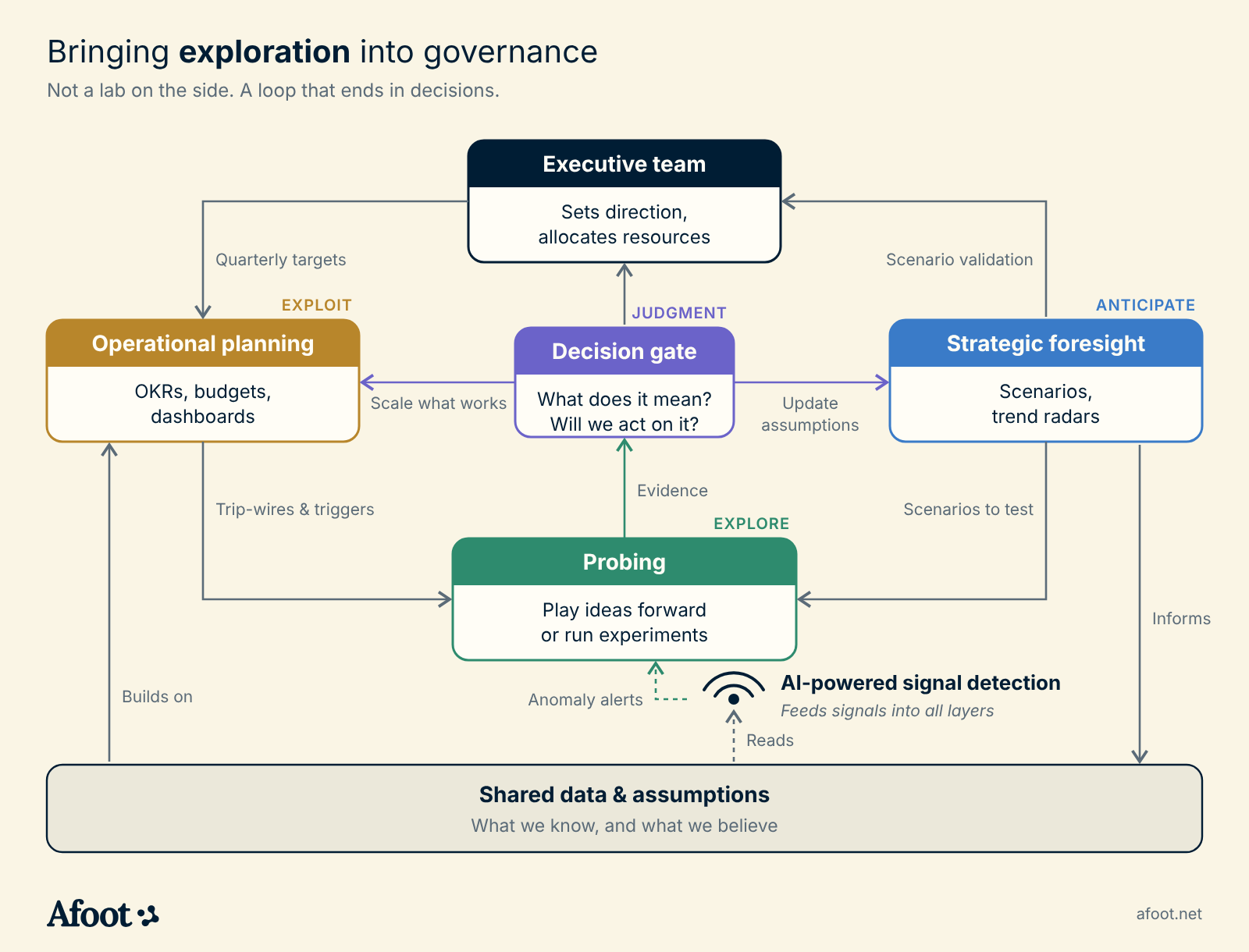
Everything starts from shared assumptions: this turns the loop into learning rather than a sequence of disconnected experiments. Every plan rests on beliefs about customers, the market and how people will behave. Very often these assumptions are invisible, so nobody knows when they’ve been proven wrong. With an explicit layer, a probe becomes “which belief did we test?”. And the AI signal detection gets something concrete to watch for. An anomaly is simply reality departing from an assumption.
Signals come in from everywhere: operational planning sets trip-wires. Strategic foresight anticipates scenarios (i.e. plots) to test. AI flags anomalies nobody was looking for.
Probing tests narratives and prototypes: small experiments, in any function. A new pitch, a pricing test, a changed handover. The goal is signal, not success: which belief held, which didn’t.
Experimental evidence goes to a decision gate: a group of people with good judgment and expertise get together and answer two questions: what does it mean? and will we act on it?
The decision gate sends the decision where it belongs: scale what works into operational planning. Update shared assumptions, so foresight and planning build on what was just learned. Escalate when immediate direction should change.
The manager’s role in the dual operating system
In the network, managers take part on equal footing with the volunteers. Rather than routing information and having veto power, as they do in the hierarchy, they act as coaches and facilitators. Most importantly, they give legitimacy to what the network commits to. They keep it aligned with the rest of the organisation and help decide where each idea will have the most impact.
AI is tuning this into something closer to a set of new jobs. In an episode of the AI Daily Brief entitled “Why agents make every job a startup”, host Nathaniel Whittemore names three:
Intrapreneur Coaches: they support the people doing the exploring with judgment, and pacing. They help people know when to push, when to pause and when to let an idea go.
Experiment Portfolio Managers: they treat experiments as a portfolio: fund, scale, merge, kill. This is the decision gate as a job, someone whose work is deciding which probes earn more resources and which have taught all they can.
Internal Agent Product Managers: they curate the company’s agent ecosystem: the tools, data, agents and policies everyone explores with. If AI is what makes probing cheap, someone has to own the quality of what people probe with, including security and privacy guardrails.
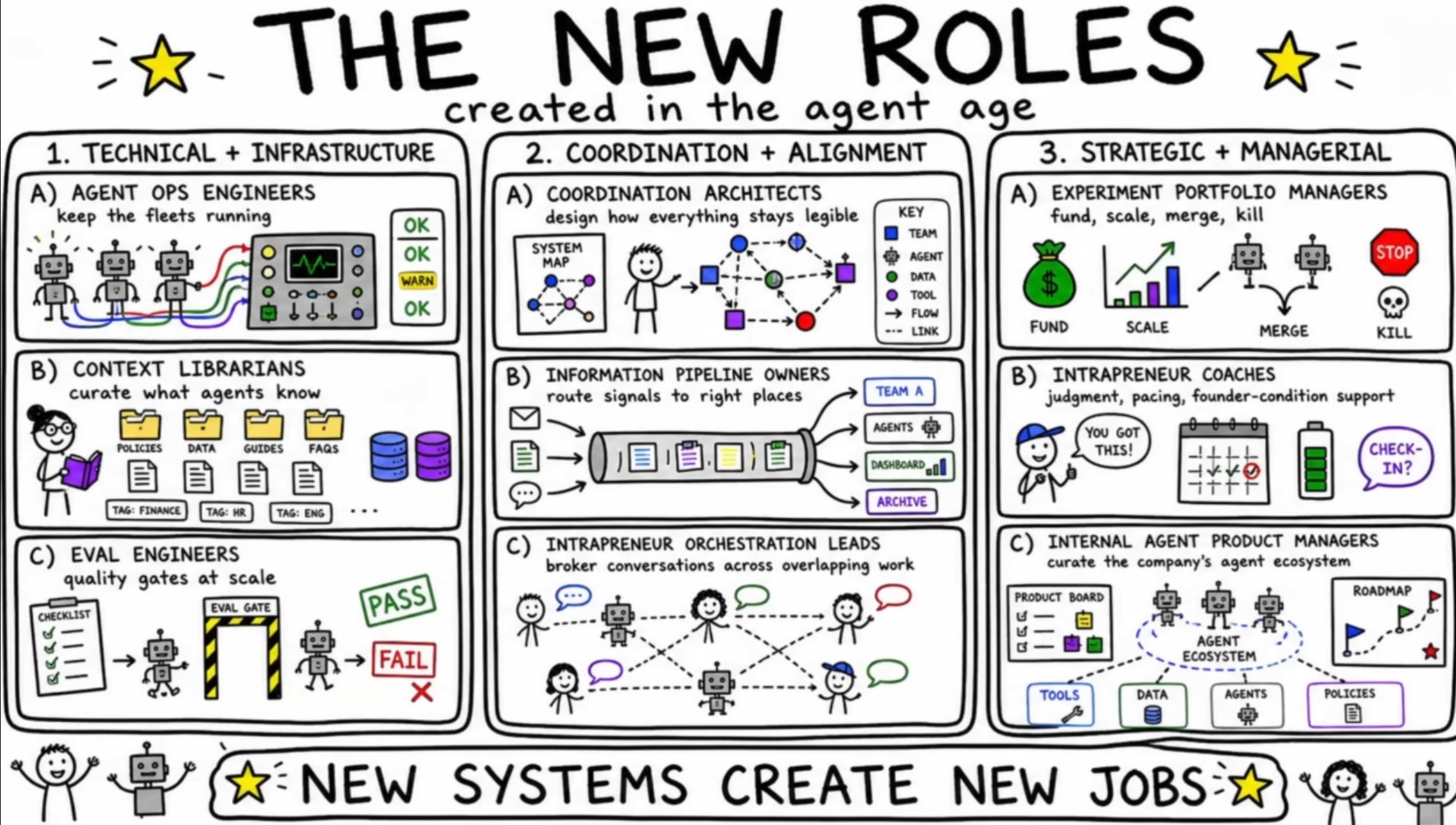
None of these is a classic manager. All three exist to help exploration reach a decision.
Innovation is a plot. Every chapter ends with a decision.
A plot is a chain of decisions. Someone acts, something happens, someone decides what it means and what comes next. Probing plays the story forward, but the decision gate is where each chapter ends.
And this is where most organisations lose the plot. The group meets to pass judgment, they weigh the evidence, they argue, they agree. The probe crossed from complex to complicated, or gets killed, or an assumption everyone relied on turns out to be wrong. Then the meeting ends, and the decision dissolves into notes nobody looks at, or a Slack thread only three people saw. The next probe builds on the assumption that just got invalidated, because nobody outside the first room was told. No decision was recorded.
Startups rarely have this problem early on. The founders are in every conversation. They remember how the last chapter ended. An intrapreneur in a large firm doesn’t have that luxury. She’s one of hundreds of people exploring things at once, across functions, each with their own rhythm.
So if every job is now a startup, and every employee an intrapreneur, then the company needs what founders carry in their heads: a shared record of what was decided, by whom, and whether it held.
That’s what we are building with Afoot. When a group makes a decision, Afoot captures it and asks the people who made it to confirm it. Once confirmed, it becomes a commitment both people and agents can act from.
The network can see which bets are open, which held and which were killed. The hierarchy can see what has crossed the gate and is now theirs to plan. And everyone can see which assumptions changed along the way.
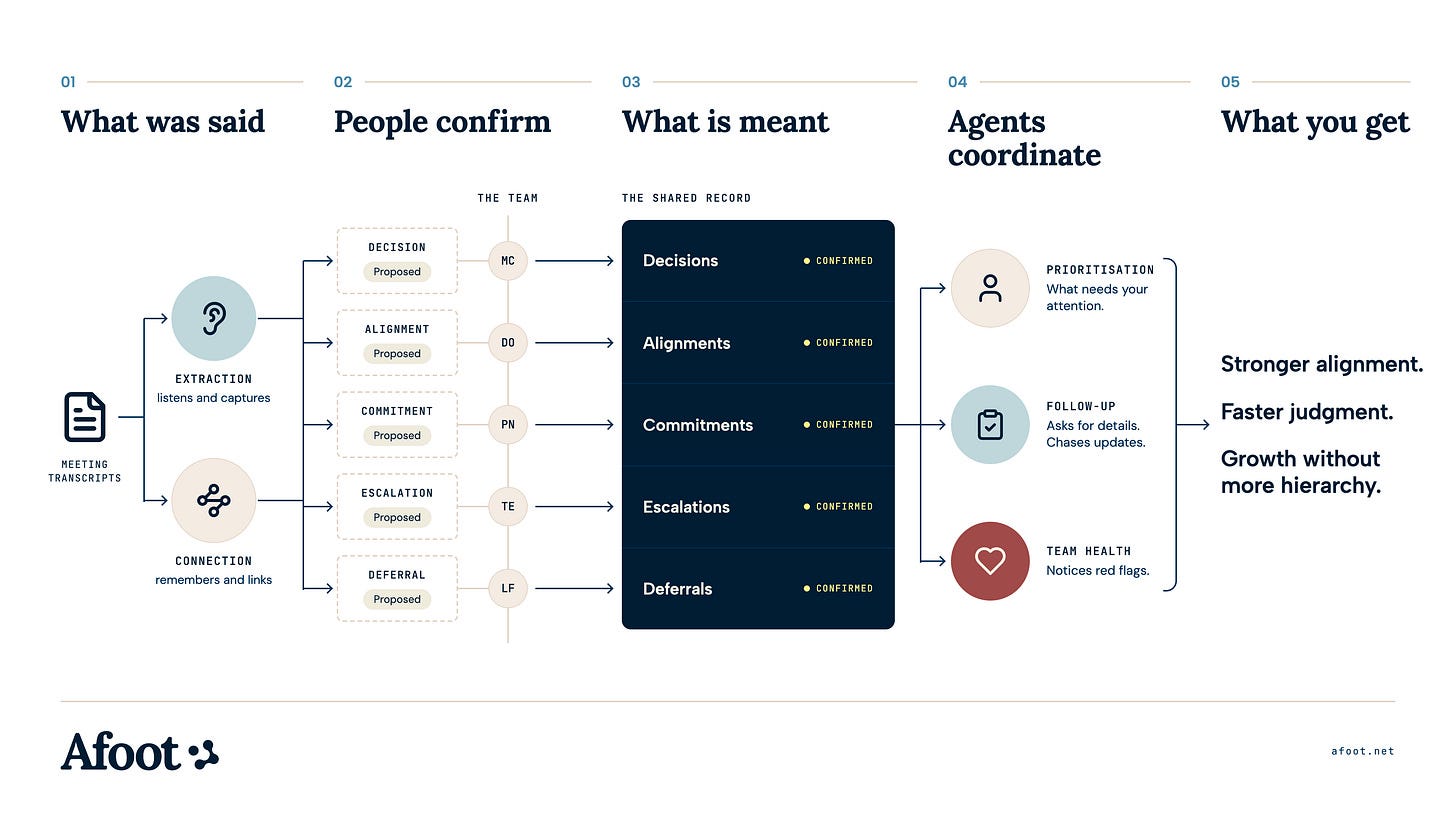
AI has given every function a lab. But without a shared record of what those labs decided, the parallel brilliance of volunteers turns into organisational entropy.
Labs don’t fail for lack of ideas. They fail for lack of a plot.
Write the next chapter with us
Afoot goes live soon and the waitlist is growing. Right now, we’re looking for a few design partners: companies where people are already exploring, where good ideas keep getting lost between the meeting and the plan, and that want the coordination infrastructure built around how they actually work.
If that’s you, email me at vanessa@afoot.net, or join the waitlist to follow our journey.
Vanessa, I’m wondering what happens six months after everyone has the freedom to experiment.
You could have a dozen people discovering better ways to work, but if nobody has the authority to retire the old processes, you’ve just added another layer of activity.
I’d want to know how many experiments actually replaced something the organization was doing before. Otherwise, innovation becomes additional work for people who were already stretched thin.
This is a fascinating take - really great read, thanks Vanessa. Also love the design language!