


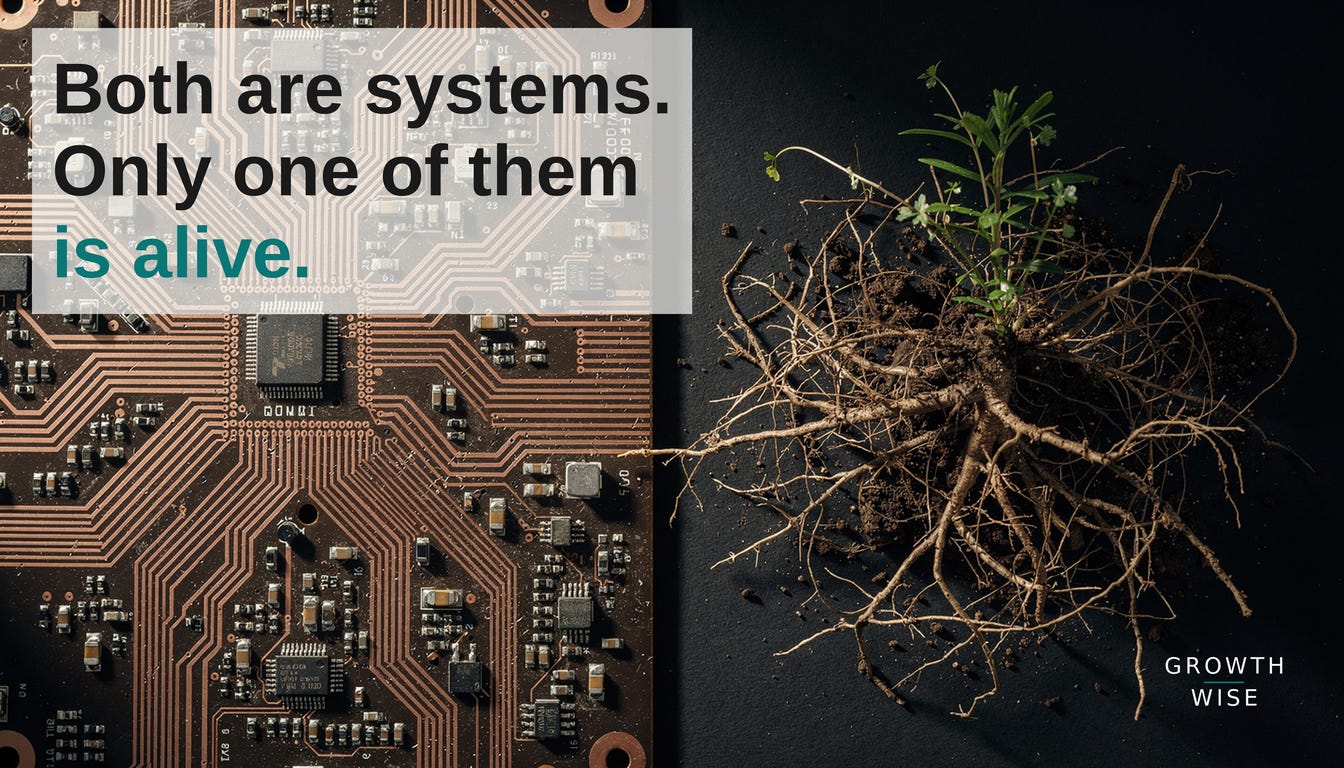
Jack Dorsey and Roelof Botha published something worth reading last month. “From Hierarchy to Intelligence” is Block’s public statement of intent to restructure itself as an AI-coordinated company, replacing layers of management with a shared world model that gives every person in the organization the context they need to act.
Dr. Tim Rayner at Superesque wrote a sharp breakdown of what Block is actually building and why it matters for founder-led teams. Read it. It’s one of the clearest accounts I’ve seen of where this is all going.
One thing he touches on deserves more attention.
The argument Dorsey and Botha are making (that AI should replace what management does: routing information, maintaining alignment, coordinating work) is the same argument I’ve been making from a different angle.
The coordination tax isn’t a people problem. It’s a system design problem. Every layer you add between a decision and the person executing it is a translation layer. Every translation layer introduces distortion. The signal degrades. The intent mutates. By the time strategy reaches execution, it has become something else.
Sangeet Paul Choudary calls this “coordination without consensus.” AI reduces the translation costs of turning one team’s outputs into another team’s inputs. You don’t need a manager in the middle to relay, interpret, and repackage. The infrastructure does it cleanly, at speed, without the loss.
Afoot is built to solve exactly this problem, at a different scale than Block but with the same underlying logic: coordination should be an infrastructure problem, not a headcount problem.
The more interesting question is what gets coordinated.
Block’s world model is ambitious. It aggregates millions of data points — transactions, decisions, code, designs, plans — into a continuously updated picture of what the organization knows and does. The AI intelligence layer reads that picture and acts on it.
But there’s a layer that picture doesn’t capture cleanly. The layer where humans are actually in a room together, negotiating reality.
The decisions that matter most don’t happen in task trackers or code repositories. They happen in conversations, where assumptions collide, where commitments get made, where the ambiguity that no document can fully resolve gets worked through in real time. That is the richest coordination moment any organization has. And it is also the most consistently under-captured.
Most organizations have already patched this with AI notetakers. The transcript exists. The summary gets generated. But a summary of what was said is not the same as a structured record of what was decided, who owns it, and what happens next. The notetaker captures the conversation. It doesn’t qualify the coordination. It doesn’t tell you whether a real commitment was made or whether people just seemed to agree. That distinction is where the signal still gets lost.
Ambiguity doesn’t announce itself. It just shows up later as a missed deadline, a relitigated decision, or a project that has to start over because nobody wrote down what was actually agreed. The cost compounds quietly.
That is the gap worth closing.
The convergence Dr. Tim Rayner identifies — between what Block is building at enterprise scale and what forward-thinking founder-led firms are building now — is real. The architecture is the same. Build a shared knowledge base. Give people access to it. Let AI do the coordination work that humans were never well suited for anyway.
The difference, as he rightly points out, is what role people play inside it.
At enterprise scale, the risk is that people become appendages. The system models the world; humans feed it data from the edges.
At the scale of a founder-led team, the opportunity is different. The knowledge base is comprehensible. The people inside it can actually inhabit it rather than just serve it. The AI amplifies what they know rather than routing around them.
There’s a more precise way to say what the bottleneck actually is, and where Afoot sits in this picture.
The goal isn’t primarily knowledge accumulation for improved automation. That framing, while part of it, misses where the real friction lives. The bottleneck has shifted upstream. Execution is getting faster every month. The bottleneck is now the moment before execution: the work people do together to create shared reality.
Coordination, properly defined, is that work. Understanding, decisions, commitments, ownership, priorities, handoffs. The moment where a group of people negotiates what is true, what matters, and who is responsible. That moment is where collective judgment actually occurs. It’s where sensemaking happens. It’s where the direction of work gets set.
And it is still, in most organizations, almost entirely unstructured.
Most world models start from the bottom up: aggregate everything, build the picture, hope coordination falls out of it. Afoot starts from the highest-fidelity moment. Synchronous dialogue sits at the top of any coordination hierarchy. Structure that layer reliably, and everything else (documents, plans, async updates, downstream systems) connects in as supporting context rather than load-bearing foundation. The constraint is the architecture.
AI notetakers capture what was said. Project tools track what gets done. Neither touches the quality of what happened in between: whether a real decision was made, whether the commitment is durable, whether the people in the room actually reached shared understanding or just moved on.
Afoot is built for that layer. The goal is to recognize where judgment happens, give it structure, and make the output of collective sensemaking durable enough to survive into execution.
The encoded knowledge matters. The more important thing is that the moment of coordination, where humans decide together, produces something real that the rest of the system can act from.
Better conversations. Cleaner commitments. A system that lets both humans and machines act from the same structured understanding.
That is the coordination architecture worth building toward.
Afoot exists to help ambitious organizations innovate and execute at a high standard by ensuring that ideas, decisions, and commitments survive into reality.